



| Main | |
| Documents & images | |
| Links | |
| Contact | |
 | |
| amazon.com |
|
|
|
amazon.com
amazon.co.uk |
|
|
|
|
amazon.com
amazon.co.uk |
|
Relocation notice: Effective 24 August 2009 the notebook section of www.historiae.org will move to a new home at gulfanalysis.wordpress.com. The new site offers features like RSS subscription, comments, thematic indexes and archives.
[Notebook for shorter news items. New entries are added intermittently but these very short and often highly speculative notes are not part of the subscription service at historiae.org. Subscriber specials (e-mail reports) from the period 2007-2008 are included towards the bottom of the page.]
10 August 2009: The Shabak React to the Atrocities of Khazna Tepe
The latest series of violent attacks against Shiite targets in Iraq has prompted the usual outpouring of stereotypical readings by international media, with the dynamics at play invariably described as sectarian “Sunni-Shiite” or ethno-sectarian “Shiite-Kurdish” in character.
This tendency is at its most pronounced in the case of the Khazna Tepe village in Nineveh governorate, where the largely Shiite Shabak minority was targeted and suffered some of the heaviest human and material losses seen in Iraq since the withdrawal of American troops from urban areas on 30 June. The Shabak are a minority with a distinct language that combines elements of Kurdish, Turkish, Farsi and Arabic; in terms of religion they are majority Shiite with a minority of Sunnis. But while leaders of the Shabak aspire to treatment as a separate ethnic minority within Iraq, numerous other communities have tried to impose their own preferred narratives in dealing with them, and it is to these dominant discourses most journalists covering the latest developments now turn.
For example, there is the practice of labelling the Shabak as “Kurds”. This reflects a conscious strategy by the Kurdish regional authorities to assert control of the Shabak (who inhabit a series of villages in what the Kurds consider “disputed” parts of the Nineveh governorate), partly by assimilating them and partly by trying to co-opt their leaders. A competing narrative emanates from certain Assyrian Christian leaders inside and outside Iraq (not least outside it), who through highly imaginative readings of the Iraqi constitution of 2005 want to prepare the ground for the establishment of a federal “minorities region” in those parts of the Nineveh governorate that are known as the “Nineveh plains”. (The strategy refers to article 125 of the Iraqi constitution which guarantees the “administrative, political, cultural, and educational rights of the various nationalities, such as Turkomen, Chaldeans, Assyrians, and all other constituents”; to read this as a green light for a second federalisation track is far-fetched in the extreme but some of these people are taken very seriously in Washington, D.C.) The idea of a separate “Assyrian” nation is in itself something of an imposition on the majority of indigenous Iraqi Christians (many of whom prefer to refer to themselves as “Iraqis of the Chaldean religion”) by an elite with ties to the Nestorian refugees from Hakkari in present-day Turkey who arrived in Iraq as late as during the First World War, but some of these leaders nevertheless think in even bigger terms by construing the demand for a “minority homeland” within Nineveh as a "shared project" between the Christians, Shabak and Turkmen of the region. Shiite Islamists of central Iraq, for their part, will doubtless portray the recent attacks as acts committed by Sunni al-Qaeda and/or remnants of the old regime against Shiite victims.
In this cacophony it may be useful to listen to what Shabak leaders themselves are saying about the attacks. So far, their key demands have been the restoration of control by the central Iraqi government, as well as the maintenance of the territorial integrity of the Nineveh governorate. Shabak leaders decry the lack of Iraqi government influence which has enabled the Kurdish Pesh Merga forces and secret police (asayish) to dominate; in the past the Shabak have repeatedly accused the Kurds of enabling these terror attacks, either turning the blind eye to the local situation or even by orchestrating the attacks themselves. A second feature of their demands has been a call for local forces to form part of the security arrangements, but in making this demand Shabak leaders are not resorting to the federalism model favoured by Assyrian activists in DC and their friends on Capitol Hill, but by evoking the concept of tribal “support councils” (majalis isnad) which Prime Minister Nuri al-Maliki introduced in 2008 as part of the domestic security agenda of the central government.
In these and most of their previous public statements, Shabak leaders seem to be at one with the dominant Sunni Arab forces of Mosul as represented by the Hadba list and its leader Athil al-Nujayfi – whose own demand that military forces of the (Shiite-dominated) central Iraqi government take control in all of Nineveh represents a remarkable rebuttal of the sectarian paradigm for understanding Iraqi politics. First and foremost, the Shabak are seeking to define themselves as an ethnic minority wihtin an Iraqi nationalist framework, with a neutral position on sectarian issues.
9 August 2009: One Shiite Aliance, Two Shiite Alliances, or a Real Inter-Sectarian Alliance?
The amazing range of divergent public statements about the revival of the UIA between May and today seems to suggest that no one is completely in control of the situation. For several weeks, Daawa (Tanzim al-Iraq) members have been circulating rumours to the effect that the 2005 line-up minus Fadila would come together again and that a new political programme had already been agreed upon. Last week, two different Sadrist statements emerged, one suggesting that the re-establishment of the UIA under a new name (the National Iraqi Alliance) was imminent, another saying more negotiations were needed. Predictions about the exact timing of the process have also varied: Some participants in the process have been adamant that a joint declaration would emerge during last week's Shaabaniyya pilgrimage; others maintain that nothing will be made public until November or at least will have to wait until there is an election law.
Meanwhile, intra-Shiite relations have been disturbed by the $7 million bank robbery in Baghdad's Karrada district last month. Initially the affair was blamed on "insurgents" but it has since emerged that people rather closer to the centres of power were involved as offenders, including a member of the security detail of Vice-President Adil Abd al-Mahdi. This has once more caused tensions in the Daawa-ISCI relationship, with opponents of ISCI even suggesting that the robbery was part of a scheme to boost the party's finances ahead of the next parliamentary elections. ISCI, for their part, are reportedly furious with the interior ministry (headed by independent Jawad al-Bulani and considered closer to Maliki) for having "exaggerated" the role of Adil Abd al-Mahdi's people in the plot, by blaming it "exclusively" on his guards instead of admitting that "only one" of them was involved... While the incident has not received a lot of attention in the Western press, it was certainly a serious one, with seven Iraqi security guards killed.
Today, a previously unknown political movement fronted by one Khalid al-Yawir and claiming support in the Sunni-dominated governorates says it has formally allied itself with Maliki. At the same time an ISCI statement suggests that the "new" UIA coalition will be announced on Thursday and will include "some Turkmens and Kurds". In their current configurations, neither of these two schemes seems particularly promising in terms of real inter-sectarian rapprochement between established political heavyweights, although the Maliki-Yawir alliance could be interesting if it should translate into more widespread cooperation with the awakening forces.
31 July 2009: Larijani, Qubbanji, and Saghir All Welcome the Camp Ashraf Operations
They may have been intended by Prime Minister Nuri al-Maliki as another piece of strongmanship that would strengthen Baghdad’s central government, but the recent operations by Iraqi government forces against the Iranian opposition group Mujahedin-e Khalq (MKO) at Camp Ashraf in Diyala governorate have been greeted in a way that suggests wider regional political dynamics. Using rhetoric that is a carbon copy of that employed by the Iranian regime, Sadr al-Din al-Qubbanji and Jalal al-Din al-Saghir, two old Khomeinists and leading preachers of the Islamic Supreme Council of Iraq (ISCI), today hailed the operations against the munafiqin or “hypocrites” in their Friday sermons in Najaf and Baghdad respectively. (The MKO are a remnant from Iraq’s Baathist period, when they were Baghdad’s favoured Iranian opposition group.) For his part, Iran’s parliamentary speaker Ali Larijani welcomed the action taken by the Iraqi government, while MKO representatives characterised the manoeuvre as an operation directed from the very top of the Iranian regime, intended as a diversionary tactic by a government that remains under heavy domestic pressure after the recent presidential elections.
It should be added that the Camp Ashraf operations took place simultaneously with the visit to Iraq by the US defence secretary, Robert Gates.
25 July 2009: Qubbanji Publicly Confirms the Sectarian Nature of the “New” UIA
Many commentators find faults with Sadr al-Din al-Qubbanji, a leading preacher of the Islamic Supreme Council of Iraq (ISCI), but whatever the critics may say, the man is certainly in the habit of speaking in a frank and unambiguous language – something that occasionally is in short supply among the Shiite Islamists of Iraq. So too yesterday, when Qubbanji told worshippers in Najaf that a regional conspiracy headed by Saudi Arabia was underway to disrupt the “Shiite–Kurdish” alliance in Iraq, possibly by destroying the Shiite-led United Iraqi Alliance (UIA) and replace it with something else. But hang on a second: Was not the “new” UIA meant to transcend this outdated language of sectarianism? Apparently not. Of course, there has been evidence of this for some time, but Qubbanji’s clarification of the essentially ethno-sectarian orientation of the UIA is useful at a time when many other Iraqi political forces are considering how to frame their alliances for the 2010 parliamentary elections.
Also yesterday, another UIA figure, Khalid al-Asadi, reiterated the line-up of the “new” UIA, as had been leaked earlier in the week as well: Daawa, ISCI, Badr, UIA independents, the Jaafari breakaway faction of the Daawa. And, according to a report in the pro-Shiite newspaper Al-Bayyina al-Jadida, Ahmad Chalabi was meeting with Ali Larijani in Tehran to consult on Iraqi affairs.
23 July 2009: Public Diplomacy Progress for Obama and Maliki
During yesterday’s brief press conference in Washington, Barack Obama found back to some of the good ideas from his first Iraq speech in February. He reiterated his respect for the way Iraqis had shown resilience against the forces of division, and he talked about national reconciliation in a relaxed fashion that did not impose particular parameters for the process. At one point he mentioned “all of Iraq’s ethnic and religious” groups, but in another instance he referred to the “people of all parts of Iraq” and there was no reference to the specific tripartite formula of “Shiites, Sunnis and Kurds” which was prominent only weeks ago during Vice-President Joe Biden’s visit. All in all, his remarks are likely to be seen as unobjectionable by a majority of Iraqis, quite regardless of what they may think of the current Iraqi government.
We do not know what was said behind the scenes, but it is quite entertaining how the Western mainstream media, by contrast, remain stuck in their own clichés. Here, reconciliation “between Shiites, Sunnis and Kurds” is the only ticket in town, even if this means having to struggle with quotation marks and sometimes even cheat. For example, in a story published yesterday morning, prior to the conference, AP reported, “U.S. officials, while praising improvement in Iraqi security forces, remain deeply concerned that al-Maliki’s Shiite Muslim-dominated government has been unable or unwilling to reconcile with the country's minority Sunni Muslims and Kurds.” (Not a single quote was provided.) Then, after the press conference, another paragraph was added to the story – this is after all the normal way this cut-and-paste industry works. It read, “President Barack Obama said he pressed Iraq’s prime minister on Wednesday to make room in his government and security forces for all ethnic and religious groups to prevent a resurgence of the violence and turmoil that took the country to the verge of civil war.” Of course, at no point had Obama referred to anything to do with cabinet or indeed security forces composition (only that the latter would have to behave in a non-sectarian fashion in order to continue to receive US backing).
The BBC was even worse. The 1900 GMT evening bulletin of world news started just before the press conference in DC and featured an interview with the Washington correspondent of the BBC, Jon Donnison. He maintained that Obama would work very hard to secure tripartite reconciliation, and he was particularly adamant that “dividing up the energy resources” between the three was key. Immediately following the live coverage of the press conference, Donnison was given another chance to offer his exegesis; this time he focused on Obama’s reference to “all of Iraq’s ethnic and religious” and then added, “I take that to mean that he wanted assurances for the Kurds and the Sunnis”! In the 2000 GMT bulletin, Donnison had grown even bolder. He now claimed that “Obama said” he was looking for changes that “better integrate Shiites, Sunnis and Kurds”. Nothing of the sort had of course been said during the press conference. But the BBC persevered with its peculiar and highly tendentious mix of fact and fiction. In its website version of the story today, it erroneously attributed the tripartite theme to Maliki: “…‘The sons of Iraq and the daughters of Iraq will be equal’, Mr Maliki said, vowing that the country’s national unity government would work to end often bitter divisions between Iraq’s Shias, Sunnis and Kurds.” Except that the “vow” was the BBC’s own invention. The subtle shift in public discourse may or may not reflect a conscious change on the part of the Obama administration about how to handle reconciliation in bilateral talks with Iraq, but in any case none of what was said publicly in the Rose Garden yesterday corroborates the “interpretations” offered by AP and the BBC.
Meanwhile, based on Maliki’s remarks at the press conference, we are coming closer to an identification of where US leverage in the bilateral relationship with Iraq actually exists: in the Iraqi quest to bring to an end the “Chapter Seven”-imposed war reparations which Baghdad still has to pay Kuwait to compensate for the 1990 invasion. A change to this would require a UN Security Council decision, and the US could probably do more to lobby other states. Why not use this constructively? Why can not the US say publicly that it wants to help Iraq get rid of the Chapter Seven burden, but that it wants reassurances that Iraqi reconciliation is indeed taking place, and that it would be far easier to help Iraq once a process towards meaningful constitutional revision (again, in general terms, not imposing any particular vision) gets going, perhaps in the context of the upcoming parliamentary elections? To establish this link in general terms would be a lot more helpful than the more specific ideas of “tripartite concord” offered by Biden earlier this month, and would also be more faithful to the spirit of Obama’s remarks yesterday and indeed his whole project of not imposing particular agendas on other countries.
22 July 2009: Uneasy Anniversary for Iraq’s Inter-Sectarian Opposition Front
[Also available in an Arabic translation kindly provided by Faisal Kadri]
One year ago, on 22 July 2008, one of the most promising political tendencies in post-2003 Iraq got a name: “The 22 July Forces”. The event which linked the date to a nascent political movement was the vote in the Iraqi parliament on a provincial elections law which took place on that day; it brought together an alliance of Sadrists, Fadila, some Daawa and independent United Iraqi Alliance (UIA) members, secularists as well as Sunni-oriented parties who all combined to support a package of transitional pre-election arrangements for Kirkuk in order to address concerns about Kurdish heavy-handedness in the disputed city.
Arguably, of course, the front could be said to be much older. In many ways, the 22 July alliance is but one of several manifestations of an inter-sectarian opposition tendency that in its spirit goes back in time at least to the early cooperation on an Iraqi nationalist platform between Sunni resistance groups and Sadrist militants back in 2004. Indeed, one could argue that this trend is the natural continuation of “normal” Iraqi politics between the 1920s and the early 1960s, when as a rule Shiite and Sunnis would participate in the same political parties (for example, the Shiite element in the Baathist party was very strong early on). In that perspective, the period in Iraqi politics between 2003 and 2007 becomes the exception and not the norm – a period dominated by the ideas of Paul Bremer and the returned exiled Iraqis, and characterised by public sectarianism on a scale never seen in Iraq before.
On the other hand, this is also an anniversary that is likely to go unrecognised by much of the outside world. The most obvious reason is that the alliance itself seems increasingly defunct and few are using the 22 July name anymore. Its initial triumphs were great: It was a precursor to this movement that secured a fixed date for the 2009 parliamentary elections during the February 2008 vote on the provincial powers law, and, during the autumn of 2008, despite presidential opposition, many of the same parties managed to maintain Kirkuk on the agenda and avoided straightforward local elections there in a setting that many local residents would deem illegitimate. But then came the vote on the SOFA in November 2008, the unseating of parliamentary speaker Mahmud Mashhadani in December 2008 (he was loyal to the 22 July group) and the election of Ayad al-Samarrai as new speaker in April 2009. Quite regardless of opposite trends at the local level (as reflected in the January 2009 provincial elections), this all seemed to suggest a return to the “old politics” of 2003–2007 inside the Iraqi parliament, and the dominance of parties that seek to entrench sectarian identities (even as they cooperate) instead of transcending them.
Today, one of the most manifest remnants of the 22 July moment could be the emerging cooperation between ex-speaker Mashhadani and Fadila leader Nadim al-Jabiri, who since around January 2009 have been fronting the new Independent Nationalist Trend, with an explicit anti-sectarian message. There have been reports about support from nationalists like Khalaf al-Ulyan and Salih al-Mutlak, as well as efforts to recruit tribal leaders from across Iraq. On the other hand, there are signs that the Sadrists, once a vital part of the 22 July alliance, could be drifting back towards the sectarian Shiite alliance (the UIA, which these days is undergoing refurbishment in order to appear to voters as a “nationalist” bloc prior to the next parliamentary elections). At least, on two crucial occasions in 2009, the Sadrists have defected from the 22 July position – by backing Samarrai for the speakership in April, and, more recently, by reportedly joining ranks with Samarrai over Kirkuk (by resisting, through its leadership of the legal committee in the Iraqi parliament, legislation that would provide special treatment for Kirkuk also in the forthcoming parliamentary elections.)
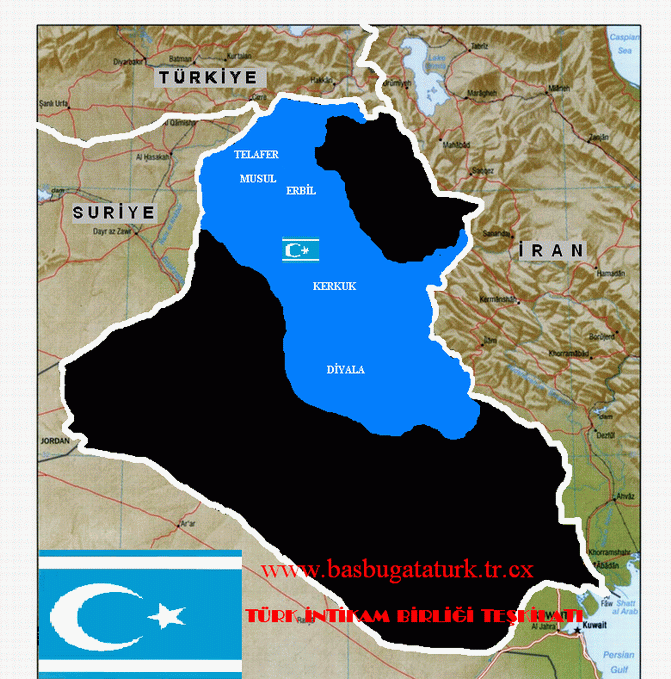
The antithesis within: A map of Turkmeneli or “the land of the Turkmens”, a vision of Iraq favoured by some members of the Turkmen community and an indication of a dualism that sometimes complicates Turkmen participation in projects like the 22 July front.
However, another of the support bases of this inheritor to the 22 July tendency may also constitute its Achilles’ heel. The issue that brought the trend to the limelight one year ago was Kirkuk and the demand for transitional power-sharing pending local elections. While the focus on ethno-sectarian quotas for Kirkuk back then was seen by many as contradictive and antithetical to the overall nationalist agenda of the 22 July front and the emphasis on rejecting such quotas, the temporary nature of the proposed arrangement to some extent mitigated this criticism back then, and left the impression of an attempt to rescue the Iraqiness of Kirkuk in the face of Kurdish domination. These days, however, in the context of the debate on the law for the next parliamentary elections, some of the adherents of the 22 July trend are making suggestions for electoral arrangements that go further in undermining their own basic position. In particular, the suggestion that Kirkuk be subdivided into four electoral districts based on ethnic identity (Kurds, Turkmens, Arabs, Christians) would serve to reify those very sectarian identities that the 22 July parties have signalled an intention to cut across.
The problem is that the 22 July alliance relies on the support of several elements that oscillate between their Iraqi and more parochial identities in ways that are sometimes contradictive. This is seen for example among the Turkmens (some of whom, not least those in exile, at times drift towards a decentralisation stand by advocating the establishment of an ethnically based federative unit in the Turkmen belt from Kirkuk to Mosul), as well as the Shabak (whose leader Hunayn al-Qaddo yesterday called for special ambassadorial quotas for the Shabak and the Yazidis; this seemed a clear example of the muhasasa principle which the front is supposed to combat). A less defensive approach would be to appreciate the considerable disdain for the established Kurdish parties among Kirkuk Kurds and to try to win them over, and to focus instead on special supervisory arrangements that could help instil confidence among local residents about the fairness of the elections. Rather than becoming bogged down in demands for special quotas in Kirkuk, the supporters of the 22 July trend could think more bravely about the upcoming elections and the prospect of bigger alliances that could include both players who are currently outside the political process as well as forces that supported Maliki in January but are unhappy about his apparent plans to return to the UIA fold. For example, the focus on deep constitutional reform among many 22 July adherents (as opposed to the window dressing revision favoured by the parties that dominated the 2005 election) could emerge as a vote winner among the Iraqi public in 2010.
21 July 2009: Maliki Under Pressure as He Visits DC
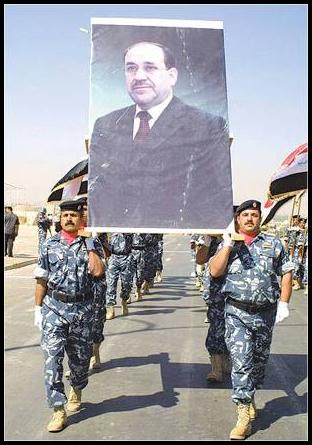
As Nuri al-Maliki visits Washington today, he already seems to be under a lot more of pressure than only four months ago, when he was celebrating the quite spectacular success of his “State of Law” list in the January local elections.
Back then, he was involved in what seemed to be real efforts to establish a genuine cross-sectarian alliance with secularists and political movements in the Sunni-majority areas of Iraq, and was talking openly about reforming “weaknesses” of the 2005 constitution that were due to the “chaotic” environment in which it had been adopted. But then followed a string of high-level visits from Iran, heavy anti-Baathist rhetoric from the Islamic Supreme Council of Iraq (ISCI), a spate of unexplained bombings in core Shiite areas, the election of Ayad al-Samarrai to the speakership of the parliament, and finally a visit to Baghdad by US Vice-president Joe Biden that seemed aimed at getting the Iraqis to once more think of themselves as three separate ethno-sectarian constituencies in need of American assistance to achieve some kind of grand political concord. And voila, these days Maliki is no longer talking about new alliances, but instead is focusing on refurbishing the Shiite sectarian alliance of the past, the United Iraqi Alliance (UIA). It was announced two days ago that the new and supposedly more “nationalist” UIA had agreed on its basic principles, but the identity of the signatories – the two Daawa branches, ISCI, the bloc of UIA independents, and, maybe, the Sadrists (some Sadrists dismiss this last bit) – emphatically suggests that this is old wine in new bottles.
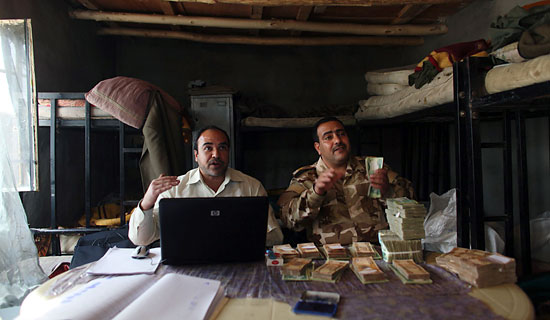
Not exactly Hammurabi: Nation building courtesy of the US Army is both recession-prone and fragile. This photo shows Sons of Iraq leaders preparing payments for its members in March 2009, supposedly to achieve “greater inclusion of the Sunnis in the new Iraq”.
From the point of view of nation building, it will be a bad thing if Maliki’s leaves DC with the impression that all the outside world expects from him is a little bit more leniency when it comes to the integration of the Sons of Iraq militias (apparently Pentagon’s idée fixe in the area of national reconciliation), as well as a slightly less confrontational approach to the Kurds over Kirkuk (the only other constitutional issue which seems to command major attention in Washington these days). Together with all the other developments over the past few months, that kind of message from the US could easily turn Iraq’s 2010 parliamentary elections into a carbon copy of those which took place in a sectarian climate back in 2005.
17 July 2009: Claiming Nothing Has Really Changed, Fadila Rejects the Offer to Rejoin a “Reformed” UIA
After weeks of speculation that their party was headed for reunification with the United Iraqi Alliance (UIA) in a supposedly new and nationalist incarnation of the Shiite bloc, Fadila leaders have now publicly said they have no such intentions. Both Hasan al-Shammari and Basim al-Sharif have said that the political programme and the overall orientation of the UIA remains the same as it always was, and that Fadila is continuing to seek other partners on a nationalist and non-sectarian basis.
At the same time, however, the driving force behind the reunification, the Islamic Supreme Council of Iraq (ISCI), seems to be making headway on two other tracks that could prove more consequential in the long run. First, its campaign to terminate dialogue between Nuri al-Maliki and secularists of various calibres (including supporters of the former regime) seems to have produced results. Whereas Maliki only months ago talked about “alliances” (in the plural), these days he, too, seems more focused on the issue of how to revamp “the alliance” (in the definite singular form, meaning the UIA). Second, reports out of Tehran suggest that Muqtada al-Sadr has met with Abd al-Aziz al-Hakim, also for the purposes of revitalising the Shiite alliance. If confirmed, this would be another partial victory for ISCI, even if local Sadrist leaders in Iraq keep talking about “preconditions” and “reservations” regarding the sectarian orientation of the UIA.
In an attempt to clear up the confusion between real cross-sectarian alliances and sectarian alliances with quasi-nationalist appearances, Rashid al-Azzawi, a member of the Iraqi Islamic Party (IIP), in an interview with Al-Sabah al-Jadid has made the point that any new credible national coalition should include established parties from both sides of the sectarian divides (instead of being a mere collection of parties from one side with some added figureheads of the opposite sect). For his part, fellow party member (now ex-member) Nur al-Din al-Hiyali is apparently trying to take a page out of the Mosul-based al-Hadba’s playbook by launching a locally focused nationalist movement, the United National Association for Nineveh Governorate, which will work to preserve the governorate’s territorial integrity in the context of challenges from the Kurds. This approach proved to be a vote-winner for al-Hadba in the January local elections, and it might turn out to be a safe bet for a cluster of seats in the upcoming parliamentary elections too.
1 July 2009: A Benign Fiasco in Baghdad
The first licensing round for Iraqi oil produced surprises and what many analysts describe as a “meagre” outcome: Only one out of eight oil and gas fields was awarded, the supergiant Rumaila field in the Basra area where a service contract was won by a consortium of BP and the Chinese CNPC. The deal followed negotiations after an initial rejection by the Iraqi oil ministry of the first offer by the Sino-British alliance. Similar situations emerged with respect to all of the other fields (except Mansuriyah gas field in Diyala for which there were no bidders), but in all of these other cases the bidders refused to climb down to the price level demanded by the Iraqi government.
With all the controversy surrounding the first licensing round, this may actually be a pretty healthy outcome. With his tough demands, oil minister Shahristani made it clear that he was at least not selling the crown jewels of Iraq’s oil wealth cheaply, although the fact that not even the Chinese were prepared to accept the fees offered by Iraq for the other fields suggests that he may have gone somewhat too far (Beijing is thought to be particularly interested in expanding its role in Iraq). Nevertheless, if the net outcome of the process is service contracts for some but not all of these fields, then it will amount to a compromise which both pro-government forces and sceptics may be able to accept. After all, it was the totality of the implications of the licensing round and particularly the prospect of a massive invasion of Iraq’s oil sector by foreigners that prompted resistance to the process. Most Iraqis agree that there is room for the IOCs in Iraq’s economy, albeit not in such a prominent capacity as that foreshadowed by the initial scenarios for the licensing round. As the Iraqi government and the bidders in coming weeks come together to seek compromise for the remaining fields, Shahristani has a unique opportunity to acquire much-needed legitimacy to his package of deals – partly by limiting the overall number of fields that are awarded, and partly by bringing in the parliament, the South Oil Company and other Iraqi oil experts.
15 June 2009: Adib Describes UIA Revival as “Iranian” Project
It is an unusual admission published in a source that must also be described as unusual, at least as far as internal Shiite power struggles are concerned. But in a recent interview in Newsweek, no less, Maliki confidant Ali al-Adib, himself no stranger to Tehran, has described the ongoing process to resuscitate the moribund United Iraqi Alliance (UIA) as an undertaking directed from the Iranian capital. “They want everyone [among the Shiite Islamists] to return to one united power”, Adib says according to Newsweek. This seems to confirm the suspicion described in previous articles and papers (see below, as well as here) to the effect that the irreducible minimum of Tehran’s desiderata in Iraq is the maintenance of a kind of politics where sectarian identities are centre stage, and where a Shiite Islamist alliance offers Iran its best guarantee of continued support.
14 June 2009: Hakim Congratulates Khamenei over the “Success” of the Presidential Elections
According to the Arabic-language Iranian television channel Al-Alam, Abd al-Aziz al-Hakim (who for the past few months has been in Tehran for cancer therapy) has sent a letter to Ali Khamenei congratulating him over the “success” of the presidential elections in Iran. Other allies of Iran in the Arab world, like Hizballah in Lebanon, have sent similar declarations of support.
The relationship between the pro-Iranian Shiite factions of Iraq and the various centres of power in Iran has always been a complicated subject. It therefore seems significant that one Iranian player who recently has been very active on the Iraqi track, Ali Larijani, has now also declared his support for Mahmud Ahmadinejad. Some observers believe that during his visit to Najaf in March, Larijani was instrumental in bringing an end to the rapprochement between Nuri al-Maliki and secularists such as Salih al-Mutlak.
31 May 2009: Here We Go Again? Maliki Visits Hakim in Tehran to Discuss a "Consolidation of the UIA"
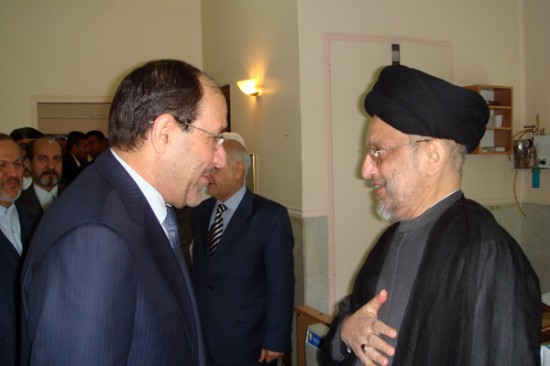
Ostensibly, the visit by Maliki to Tehran was for "private" reasons, but he did manage to find time in his schedule to visit Abd al-Aziz al-Hakim of ISCI. According to a press release, both men stressed the importance of "strengthening" the United Iraqi Alliance.
23 May 2009: Zurfi Takes Over as Governor in Najaf; Maliki Participates in UIA Revival Talks
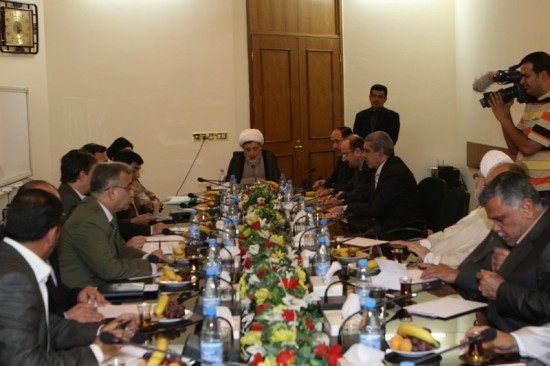
Playing second fiddle? Nuri al-Maliki seated to the right of Humam Hammudi at UIA revival talks
Nuri al-Maliki’s ally Adnan al-Zurfi has finally assumed the governorship of Najaf, after initial attempts by the Islamic Supreme Council of Iraq (ISCI) to mount a legal challenge to his candidacy (see entry for 8 May, below). Part of the story is an internal Shiite quarrel about the authenticity of a letter from the legal committee of the Iraqi parliament, ostensibly signed by the Sadrist Baha al-Araji and supporting the challenge by ISCI to Zirfi. Araji now claims the letter is false and that he could not have possibly signed it since he was in Istanbul with Muqtada al-Sadr on the 3 May, when the letter was issued.
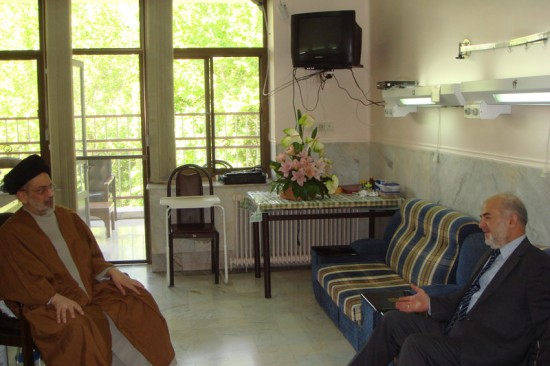
Meanwhile, whereas Maliki’s comments to al-Hurra television on 14 May about “majority rule” have been rendered with an unduly sectarian tinge in Western media (he also condemned the concept of sectarian-based alliances), it does seem both significant and worrisome to those who prefer a non-sectarian political atmosphere that he did participate on 20 May in a meeting presided over by ISCI's Humam Hammudi and aimed at reviving the Shiite-led United Iraqi Alliance (see also entry for 13 May below). The meeting comes in the middle of a hectic round of consultations between ISCI's leader Abd al-Aziz al-Hakim and various leading ISCI and Badr figures, apparently all taking place in Tehran where Hakim is being treated for cancer (photos below).
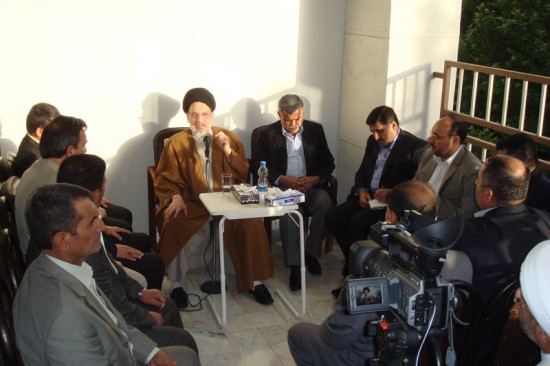
Abd al-Aziz al-Hakim meeting with senior Iraqi Badr figures on 22 May. The balcony and the furniture look very similar to the photograph of Hakim meeting with Ibrahim al-Jaafari below, confirmed as having been taken in the Iranian capital Tehran on 20 May 2009
18 May 2009: The Iraqi Oil Ministry Clarifies Its Position on Oil Exports from Kurdistan and the DNO Deal
The two last weeks have seen considerable confusion about the Iraqi oil ministry’s position concerning oil exports from Kurdistan, where the regional authorities have signed a number of exploration and drilling deals with foreign oil companies without consulting Baghdad. News that Baghdad had given the go-ahead for exports from the fields concerned by these deals prompted wild news reports about some kind of “grand compromise” between the Kurds and Baghdad on an oil law, which has stalled since the first drafts were written back in 2006. However it soon became clear that there was no compromise at all, as the Iraqi oil ministry stated that it still does not recognise the deals that the Kurds have cut with foreign companies. Accordingly, the only interpretation that could reconcile the seemingly contradictive position by the Iraqi oil ministry would be that Baghdad would allow exports to go ahead, but would at the same time keep the oil income for itself in the centrally managed account before redistributing back to the Kurds the 17% agreed as Kurdistan’s share during the annual budget negotiations earlier this year. This, of course, would involve no payment to the foreign companies concerned: DNO (a small private Norwegian company) at Tawke, and the Turkish-Canadian joint venture that is involved at Taq Taq.
In interviews with the Arab press, Iraq’s oil minister Husayn al-Shahristani has now confirmed that this is indeed the way he intends to handle matters. In principle the Kurds are free to export oil from these fields. However, Baghdad will do the marketing, and all the revenue from these and Iraq’s other oil exports (the vast majority of which come from Basra) will be pooled into a central account controlled by Baghdad, from which the Kurdistan Regional Government (KRG) in turn will receive its allocated 17%. The problem of how and whether to compensate the foreign companies involved will therefore most likely be left to the KRG, since it would be exceedingly difficult for Baghdad to pay any money for contracts it does not recognise. (Shahristani has offered to consider any contract that is submitted to Baghdad for review, but so far this has not been done by the Kurds because a key stumbling block in the oil-law and constitutional-review negotiations is that Kurdish politicians believe this kind of decision should be a regional prerogative. Also, Shahristani's stance on this makes it perfectly clear that for the moment he does not see any difference between deals agreed before the drafting of the oil law in 2006/2007 and later contracts, a distinction which some of the foreign companies with agreements dating back to 2005 like to make.)
If Shahristani stands by his current position, this situation will involve dilemmas for the KRG. Like other administrative entities in Iraq (elsewhere known as non-federal muhafazas or provinces), the KRG will receive its share of Iraq’s total oil income. But even if the agreed share of 17% for Kurdistan is generally seen as inflated in proportion to the relevant demographic numbers, the KRG will have a problem in that it will probably have to use these funds to pay DNO (which apparently will not get any money from Baghdad) for operating the field. This could leave a net economic result that is worse for Kurdistan than other administrative entities in Iraq, which can use the oil money they receive in its entirety to finance local services for their inhabitants, without having to worry about payments to foreign companies.
This leaves Kurdish authorities with the quandary of whether they should pay the foreign companies in order to honour their own contracts or not. It is probably painfully clear to them that if the contracts had been submitted to Baghdad, Kurdistan would have received exactly the same sum of money without having had to pay anything to the foreign companies (who would instead be paid by Baghdad – that is, if the contracts were found to be “in Iraq’s interests”, as Shahristani has described it). True, Shahristani, too, is under considerable pressure to boost oil exports, but if he should choose to suddenly turn around and accept both production sharing agreements (PSAs) with two foreign companies and regional negotiation rights – traditionally red lines for Baghdad politicians – angry reactions inside and outside the Iraqi parliament would likely follow. There the mood is that Iraq can still afford to keep the constitutional process and the question of foreign oil investment separate from each other, without having to surrender entirely to foreign investors and the forces of international capitalism.
13 May 2009: Hammudi Tapped for Leadership Role in Reviving the United Iraqi Alliance
According to a brief press release of today’s date described as “very important” by the Islamic Supreme Council of Iraq (ISCI), Abd al-Aziz al-Hakim has charged another prominent ISCI figure, Humam Hammudi, with the job of reviving the (all-Shiite) United Iraqi Alliance (UIA). The communiqué lists the achievements of the UIA until this date but warns that Iraq's future challenges, and especially the threat from insurgents (whether Islamists or Baathists), are such that no disunity between the UIA components can be allowed.
Of course, disunity inside the UIA has been the dominant theme since at least the summer of 2008 (when even its perceived centre began to crumble), to the point where the alliance today is almost defunct. But when Maliki in March tried to go ahead with forming provincial councils on an anti-ISCI platform and reached out to secularists and Sunni parties that are unfriendly with ISCI, criticism from inside the Shiite community (and most likely from Iran too) soon manifested itself. Going forward, the fate of Hammudi’s UIA mission will be an important indicator of what kind of political climate we can expect from the next parliamentary elections in Iraq, and above all whether the politics of fear will continue to prevail (more on the UIA revival scheme here).
10 May 2009: Maliki Makes a Concession to Basra Regionalism?
News reports from Basra suggest that Iraq’s Prime Minister Nuri al-Maliki has made an interesting concession to regionalist sentiment in the southern oil-export city of Basra. According to a statement by the spokesman of the new governor in Basra (who is also a Maliki ally), one half US dollar will henceforth be deducted from every barrel of oil exported from Basra and placed in a special development fund for Basra.
In some ways, the move could be seen as compatible with – and indeed inspired by – the 2005 constitution, where a general provision for a temporary positive discrimination of particularly deprived governorates through the use of oil revenue is found. Most statistical surveys single out Basra as the area of Iraq where living standards remain at the lowest level, in glaring contrast to the governorate’s position as the major oil producer and exporter in Iraq.
However, while the relevant constitutional clauses focus on deprivation, the link to Basra’s role as producer has other roots. The half-dollar deduction will meet a long-standing demand by Basra politicians that their area’s role as the kingpin of Iraq’s economy be reflected in some kind of special political privilege. Actually, back in December 2007, Basra politicians of the Fadila party proposed an arrangement which is remarkably similar to what is now being talked about as a governmental "decision": Basra should receive one dollar per barrel of oil exported from the south. The difference between Fadila in 2007 and Maliki in 2009 of half a dollar can reasonably be attributed to the general decline in oil prices and a bit of bazaar-style haggling between centre and periphery.
While one incarnation of Basra regionalism was roundly rejected by the local citizens as they chose to ignore the federalism initiative headed by Wail Abd al-Latif in the winter of 2008/2009, the apparent decision of a centralist like Nuri al-Maliki to make concessions to local sentiment even after his particularly strong result in Basra in the January provincial elections testifies to its survival in other forms. One cannot help wondering, though, whether this is really a decision that the prime minister is in a position to make without at least a little consultation with the Iraqi parliament?
8 May 2009: ISCI Keeps Fighting for the Najaf Governorship
Just days after the provincial council of Najaf voted in favour of Adnan al-Zurfi as new governor – backed by a pro-Maliki alliance and against the votes of the Islamic Supreme Council of Iraq (ISCI) – a legal challenge against Zurfi’s accession to the governorship has been mounted.
Technically, the challenge has been initiated by the legal committee of the Iraqi parliament. Unsurprisingly, however, ISCI’s governor candidate for Najaf and Zurfi’s main competitor, Asaad Abu Gulal, has been foremost in publicising the decision, with a special press conference in Najaf on 4 May. The decision itself is procedural and relates to the way in which an extraordinary convening of the provincial council rather than a regular meeting produced the vote in favour of Zurfi, after an earlier meeting had ended inconclusively and without immediate recourse to the legally-mandated second round of voting for the two candidates with the highest number of votes. While all of this may be true, it has to be said that this sudden upsurge of fervent legalism by members of the Iraqi parliament does come across as somewhat remarkable in a context where the existing Iraqi legal framework has been routinely tested, bent and violated in a number of other key decisions relating to both provincial government as well as the constitutional provisions themselves. Also, the ISCI representatives and their partners did show up for the disputed vote and cast their ballots; the criticism of the decision to go ahead with the meeting seems to have emerged retrospectively.
An interesting detail in all of this is that the letter from the legal committee of the Iraqi parliament communicating the rejection of the pro-Maliki Zurfi’s right to be governor was signed by Baha al-Araji, a prominent Sadrist and ostensibly an ally of Maliki at the moment. Back in 2007 he did something similar which also hurt the Maliki government, except that on that occasion his letter served to protect Basra governor Muhammad al-Waili against the combined efforts of Daawa and ISCI (then allies) to oust him from his job through a vote of no confidence. As such, this latest move, which may now end up being settled by the Iraqi federal supreme court, could be an indication of which way winds are blowing at least inside the “parliament of 2005” and some Shiite Islamist circles.
1 May 2009: Mixed Outcome for Maliki as Muthanna and Najaf Elect New Governors
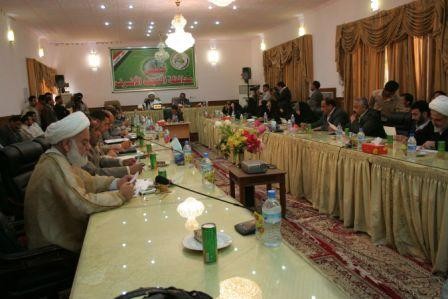
The Najaf provincial assembly
Through selecting Ibrahim Salman al-Mayali as new governor on 30 April, the provincial council of Muthanna became the third of the nine Shiite-majority governorates south of Baghdad to emerge with a stronger than expected position for the Islamic Supreme Council of Iraq (ISCI) after their setback in the January local elections.
Even if the Muthanna council was always going to be a difficult one for Maliki given the high degree of fragmentation (9 parties are represented in the 26-man chamber, with no single list counting more than 5 representatives), the outcome may be an indicator of some of the internal Shiite resistance to the direction of his policies at the national level. Just a little more than a month ago, Maliki’s coalition believed it commanded the loyalties of around 14 members of the council, just enough to form a coalition. But then things changed, and a 13-13 stalemate ensued in early April. And now, yesterday, Mayali, originally an independent member of Maliki’s coalition list, defected so that the pro-ISCI members of the council could elect him with 14 votes as the 12 remaining Maliki loyalists absented themselves from the proceedings. The council also voted for pro-ISCI figures as head of the provincial council and as deputies to the governor.
On the other hand, in Najaf, things went Malikis way, as Adnan al-Zurfi, member of a secularist-leaning local list who served as governor of Najaf under Ayad Allawi back in 2004, was voted in as governor today, against the votes of ISCI. The outcome is remarkable because Najaf is one of the few places in Iraq where there seemed to be genuine enthusiasm among segments of the population for the pro-federal ISCI-led regime that lasted from 2005 to 2009, in this case under Asaad Abu Gulal. Abu Gulal was ISCI’s candidate this time too, reportedly after an internal split had caused friction as some members of the Badr Organization had wanted the former deputy governor, Abd al-Husayn Abtan, to stand instead.
Iraqi commentators are divided as to the reasons for the long delays in forming councils south of Baghdad, which only was completed today with these two latest appointments. Some claim that there existed some kind of central agreement on creating a repeat at the provincial level of the all-Shiite United Iraqi Alliance from the 2005 national elections (and hence, a rapprochement between Daawa and ISCI), and that any divergences from this model can be attributed to squabbling of a very local character. (As late as two days ago, for instance, there were reports that agreement had been reached to split the Muthanna posts according to a complex formula in which one coalition would obtain the governor position as well as the deputy of the speaker of the council, and the other would get the speakership as well as the two deputies of the governor.) This interpretation, however, seems to discount the fact that Maliki very clearly did make attempts at some kind of dialogue with anti-ISCI Sunnis and secularists (such as Salih al-Mutlak) back in March, which would have meant an alliance on the pattern of the 22 July parties (the inter-sectarian coalition that last year demanded special arrangements for Kirkuk to reduce Kurdish influence there) and the logical opposite of a return to the UIA. And in Najaf, too, there seems to be a case of Maliki preferring to distance himself of ISCI instead of rebuilding an alliance focused on sectarian unity. The selection of Zurfi may prove controversial among some Sadrists (many of whom were in conflict with him back in 2004 and may not have been impressed by the reconciliatory moves he made towards the end of his tenure), and therefore appears to be another example of Maliki trying to build bridges with secularist circles rather than stressing sectarian unity at any cost.
In sum, Maliki apparently pursued a policy of confrontation with ISCI in seven out of nine governorates. This ultimately succeeded in six places (Basra, Dhi Qar, Qadisiyya, Babel, Najaf and Karbala) and failed in Muthanna. In Maysan and Wasit, a different policy of cooperation with ISCI prevailed.
25 March 2009: The Powers That Be Feel the Pinch – Or Even an Identity Crisis?
The contradictions within the Maliki government were of course apparent long before the January 2009 elections, but the results of those elections have certainly accentuated internal divisions. Already in 2008, there were plenty of examples of intra-Shiite competition between Daawa and the Islamic Supreme Council for the Revolution of Iraq (ISCI). In an interesting new development, the remnants of the Tawafuq bloc have recently criticised the decision of the Iraqi federal supreme court to postpone to 8 April its ruling on what constitutes an “absolute majority” (see previous entry), accusing it of being “politicised”, i.e. not supporting their own favourite Ayad al-Samarrai as the new parliamentary speaker. In other words, the “powers that be” bloc (whose nucleus was always KDP/PUK/ISCI/IIP) criticises unspecified other parties for being, well, the powers that be!
Meanwhile, ISCI is employing its favourite weapon, anti-Baathism, to try to recover some of the ground it lost during the local elections. Iran seems pleased at the idea of a return to a more sectarian discourse, and there will always be Sadrists prepared to join this bandwagon – regardless of continued efforts by others in their camp to work in a more cross-sectarian direction. As for Maliki’s opening towards cooperation with Salih al-Mutlak in local government, this is arguably some of the most courageous and quintessentially Iraqi he has done as premier. And while the forces that push in a more sectarian direction remain formidable, Maliki should take comfort from some of the more implicit reactions from other corners. When the Hadba bloc in Mosul calls for Iraqi central government forces to replace the Kurdish peshmerga this is undeniably also a step in the direction of recognising the idea of a non-sectarian Iraqi army as an achievable objective.
5 March 2009: Imposing the Law? What Law???
Today’s announcement by Tawafuq member Umar Karbuli that the Iraqi parliament will wait until 14 April to revert to the issue of who should be the speaker of the assembly and also seek advice from the supreme federal court is interesting for two reasons. Firstly, the issue where legal “clarification” is sought is one on which the often-ambiguous Iraqi constitution of 2005 actually appears to be crystal-clear: the president is to be elected with an “absolute majority of the total members of the assembly”. Exactly the same wording is used to define the quorum of the assembly, which has always been considered to be half of the total number of members plus one, i.e. 138 out of 275. When something else has been intended, the expression “simple (basita) majority” has been used, or there is reference to “a majority of those who voted” (as in the constitutional revision clause). Obviously this is an attempt by Tawafuq and its allies to circumvent the requirement of 138 votes, which proved too difficult last time an attempt was made (Ayad al-Samarrai received 136 or 137 votes on 20 February).
Secondly, this issue is interesting because Daawa members and advisers to Nuri al-Maliki have expressed somewhat divergent views on the question of seeking advice from the high court. On 21 February, Haydar al-Abbadi expressed satisfaction about this kind of procedure, highlighting his confidence that the court would maintain the view that an absolute majority would have to be calculated on the basis of the total number of assembly members. But one day earlier, Hasan al-Sunayd had indicated that he preferred the election of the candidate with the highest number of votes, regardless of the requirement of an absolute majority. So far, Daawa has vacillated in the speaker issue, reportedly voting blank on 20 February (and hence against Samarrai, who is the candidate of the ISCI-KDP-PUK-Tawafuq bloc).
This is of course not the first time Iraqi parliamentarians have treated the 2005 constitution in a creative fashion. For example, all the timelines relating to constitutional revision have been arbitrarily extended and now appear to be largely forgotten.
8 February 2009: The 22 July Opposition Alliance Is Still Alive and Well – and Gets Some Support from Maliki
The 22 July alliance, the much-overlooked nascent force of Iraqi politics that on 22 July 2008 voted in favour of an elections law that challenged Kurdish dominance in the disputed city of Kirkuk, appears to be rising again – this time in relation to the ongoing dispute over who should be the next speaker of the Iraqi parliament. Ever since the resignation of Mahmud al-Mashhadani in December 2008, the 22 July bloc has asserted itself as an Iraqi nationalist critic of the idea of restricting the vacant post to Sunni candidates only. Today, this sentiment was repeated, as a cross-sectarian group of parliamentarians from Fadila, the Sadrists and the two Hiwar factions (Ulyan and Mutlak) left the Iraqi parliament in protest as attempts were made to force through a decision on a new speaker. (Al-Iraqiyya is not mentioned in today’s press reports; they normally follow the 22 July bloc.)
It is especially noteworthy that in its latest walkout from the Iraqi parliament, the 22 July bloc was accompanied by members of the two Daawa branches loyal to Nuri al-Maliki, the Iraqi premier. This is remarkable for two reasons. Firstly, it means that Maliki once more is emphasising his ideological differences with his government coalition partners over what Iraq’s state structure should look like. The principal feature of the 22 July trend is rejection of key aspects of the post-2003 US-sponsored system of government in Iraq, including certain features of the 2005 constitution such as its latitude for a deeply decentralised state based on a system of ethno-sectarian quota-sharing. In relation to the debate over who should be the next speaker, the 22 July parties have once more emphasised this anti-sectarian approach, with outgoing speaker Mahmud al-Mashhadani firmly revolting against the system by proposing a (Shiite) Sadrist to succeed him instead of “whichever Sunni the Sunnis agree on” – the formula of the parties behind the 2005 constitution (KDP, PUK, ISCI). Secondly, Maliki’s “defection” to the opposition should give pause to all those policy-makers in the West who have considered some kind of “balance of power between sectarian leaders” as the key to Iraq’s future stability. Today, Maliki is of course spoken of by Western media as the big nationalist and even secularist. While some of this seems to be an exaggeration (especially the secularism bit), positive tendencies are certainly there, most convincingly in Maliki’s turn to centralism and the vision of an Arab–Kurdish federation rather than wasting any more time in a labyrinth of possible and impossible federation schemes south of Kurdistan. But importantly, these positive tendencies are accompanied by an attempt to reach out ideologically to the opposition, with which Maliki shares many preferences as regards state structure and anti-federalism. It cannot escape notice that these are all the parties that the United States have consistently chosen to ignore in its search for partners in Iraq.
Left behind in the Iraqi parliament sat representatives of the two Kurdish parties and the Islamic Supreme Council of Iraq (ISCI), Washington’s (and sometimes Iran’s) best friends in Iraq, still trying to convince the Americans that they have the necessary votes to get rid of Maliki. Except that they don’t. (A simple-majority vote is sufficient to elect a new speaker.) It is high time that US policy-makers abandon any plans to make further concessions to this group of opportunists (such as a “big compromise on Kirkuk”) in some kind of “final settlement” in Iraq. Instead, a more profound overhaul of the Iraqi political system is needed, with institutional checks against the quota-sharing system that a large group of Iraqi parliamentarians are now rebelling against. For whereas some Daawa figures now more openly than ever cultivate ties with the opposition, there are also more sectarian forces in motion seeking to revive the (all-Shiite) United Iraqi Alliance, something that could easily bring Iraq back to the backward political atmosphere of 2005–2006. Hence, only when Maliki moves in the direction of constitutional revision will his flirtation with the 22 July parties and his conversion to Iraqi nationalism become truly convincing.
18 January 2009: Daawa Sides with the Opposition in Parliament (But Quarrels with Them in Wasit)
In an interesting move, a member of Hizb al-Daawa (Tanzim al-Iraq), Abd al-Hadi al-Hasani, has signalled sympathy with the views of the opposition in the question of who should succeed Mahmud al-Mashhadani as parliamentary speaker (see entry for 23 December 2008 below). While the main coalition partners of Nuri al-Maliki – ISCI and the two Kurdish parties – are determined to elect a Sunni replacement from the remnants of the Tawafuq bloc in order to keep the system of ethno-sectarian quota-sharing afloat (this in turn gives them, as purported representatives of “Kurdish” and “Shiite” interests, even greater privileges), the “opposition” (featuring the Sadrists, the secular Iraqiyya, the breakaway factions of Tawafuq, sometimes Fadila, and occasionally independents) has insisted on an open contest where the speaker should be elected on the basis of merit only. This development echoes tendencies seen in early 2008 when the Daawa factions broke with its coalition partners over statements concerning Kirkuk and oil, and later faced off against the Kurds and ISCI over the provincial powers law. Thus in the question of state structure, the division lines between the nationalist opposition and the largely pro-federal government are blurred, because here Daawa sympathises with the view of the opposition, though without letting this bring about a change of its coalition partners. The contradictions of this position became clear in Wasit recently, where a quarrel between an Iraqiyya candidate and Daawa reportedly prompted Nuri al-Maliki to abruptly appoint a new police chief – a decision which ISCI members in the local council in turn seized on in order to make the case for their decentralisation agenda (though this time rather modestly so, with a reference to the Transitional Administrative Law, and on behalf of the existing governorate rather than in the name of any imagined federal entity). More than one Daawa politician have recently hinted at a possible plot aimed at unseating Maliki, but it is also possible that this latest move in parliament could be yet another attempt at playing the centralist/nationalist card in the context of the upcoming provincial elections.
PS: On 19 January, the Iraqi parliament decided to postpone the vote on a new parliamentary speaker until 4 February (i.e. after the 31 January provincial elections), thereby effectively depriving Iraqi voters of an opportunity to see for themselves which parties are truly sincere when they claim they are against ethno-sectarian quotas and in favour of a strategy that puts Iraq first.
11 January 2009: The Sadrist Parliamentary Bloc Confirms Its Support of Two Electoral Lists
The Sadrist bloc has today officially confirmed that it does indeed support the “Blamelessness and Reconstruction” list in the forthcoming local elections (list 376; as discussed earlier here), in addition to the “Independent Trend of the Noble Ones” (Tayyar al-ahrar al-mustaqill, list 284). In Maysan, for example, some Sadrist members of the current provincial council now appear on list 284; others are on list 376. List 284 is also running in some northern governorates where 376 does not take part, such as Nineveh and Diyala (but not Anbar and Salahaddin).
This development underlines the trend towards political participation among the Sadrist bloc in the Iraqi parliament, which was invigorated in 2008 as the party became a key player in the 22 July alliance that challenged the government by demanding early elections (the provincial powers law in February) and special treatment of Kirkuk (the elections law, finally adopted in September). This alliance continues to exercise strong influence in the Iraqi parliament, and Sadrists are currently vocal proponents for a drive to reject Ayad al-Samarrai as new parliamentary speaker after he was nominated by the pro-government Tawafuq alliance (which itself is in the process of being reduced to the Iraqi Islamic Party due to defections to 22 July). The 22 July parties, a cross-sectarian alliance of Islamist and secularist parties, challenge the establishment and their preference for a state model of ethno-religious quota-sharing (muhasasa).
8 January 2009: Baghdad, District of the Green Zone??
The debate about Iraq’s state structure rarely fails to make perplexing twists and turns, and the latest discussion concerning the status of Baghdad as Iraq’s capital city is no exception. In a scheme reported by several Arabic news media, local politicians in the Baghdad governorate council have presented the vision of the Green Zone as the future federal capital of Iraq – on pattern of the special status that Washington, D.C. has in the US system of government, with the rest of the governorate presumably acquiring a “normal” status (and with small chunks of neighbouring city quarters being annexed).
One would perhaps have thought that this kind of scheme could have originated with ISCI, the only party among the Shiites that has spoken out in defence of sectarian models of federalism, because theoretically it might then become easier for any future Shiite federal region to eat into parts of Baghdad. ISCI members have distinguished themselves in the Iraqi federalism debate earlier also by highlighting the option of federalising Baghdad as a standalone unit (it is constitutionally barred from becoming part of any other region under the current system). And, indeed, ISCI’s provincial council head in Baghdad, Mu‘in al-Kazimi, has been among the foremost promoters of these new ideas.
More surprising, however, is it to find Daawa member Salah Abd al-Razzaq speaking positively about this kind of project. Only months ago, he was in the media spotlight as the Daawa decided to contest the forthcoming 31 January local elections on a separate list from ISCI, not least because of disagreement between the now more centralist Daawa and the strongly pro-federal ISCI. Back then, many “centralist” independents in the United Iraqi Alliance camp that are believed to be in regular touch with Sistani, such as Husayn al-Shahristani and Safa al-Din al-Safi, chose Maliki’s side rather than Abd al-Aziz al-Hakim’s. But now also Abd al-Razzaq from Maliki’s group has signalled interest in the “federal district” plan.
It is hard to see how the scheme fits with the 2005 constitution, where even in a general tendency of extreme concessions to the centrifugal forces in Iraq at least the concept of an undivided capital seems to survive. Baghdad “with its municipal borders” is the capital of the Republic of Iraq “and shall make up the governorate of Baghdad”. One can understand the dilemma of local councillors who feel that urban development may not receive the attention it requires when the governorate of Baghdad is also tasked with matters relating to the infrastructure of the federal government, but Baghdad has such a symbolic position as the nation’s capital that any tinkering with its status is likely to meet with considerable scepticism among the Iraqi public at large. An initial challenge would be to find a reasonable name for the new creation.
4 January 2009: Ahmadinejad Praises Maliki for the SOFA
So maybe the prospect of a timetabled US withdrawal not involving political reform in Iraq was after all quite acceptable to Tehran? Iranian president Mahmud Ahmadinejad certainly spun it that way after his meeting with Nuri al-Maliki in Tehran, describing the SOFA as a “pact of withdrawal”. Later, Maliki met with Iran's supreme leader, Ali Khamenei. This time, the Iraqi premier appears to have kept his tie on for the duration of the meeting (he was criticised for not having done so last time, in deference to Iranian post-1979 custom) but this symbolic assertion of Iraqi distinctiveness apart, the Iranian hosts generally seemed pleased about the turn of events in their neighbouring country.
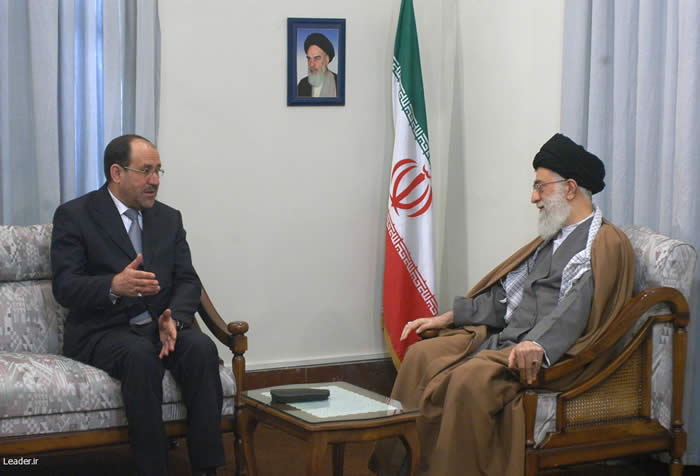
Spot the difference: Nuri al-Maliki meeting with Ali Khamenei in January 2009 (above) and June 2008 (below)

2 January 2009: Local Democracy, ISCI-style
ISCI preacher Jalal al-Din al-Saghir on Friday proclaimed that there was a foreign conspiracy at work to “split the vote” in the forthcoming local elections in Iraq. The existence of small parties, in particular, was seen as offensive by Saghir, who encouraged smaller lists to withdraw from the elections as soon as possible to leave space for the bigger parties. But then again ISCI fought hard against these elections in the first place, and later on tried to resist the introduction of open lists and individual candidacies.
29 December 2008: Askari Repeats Accusations of a Plot to Unseat Maliki
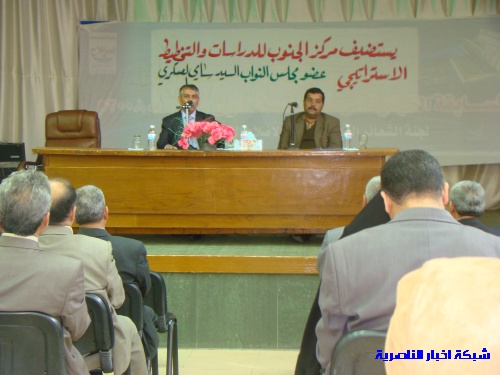
It seems significant that Sami al-Askari, a close confidant of Nuri al-Maliki, today repeated accusations to the effect that the ethno-sectarian federalists of the Baghdad parliament (KDP, PUK, ISCI, and a reluctant IIP) had plans to try to vote the Iraqi premier out of office. This conspiracy theory was first articulated by ousted parliamentary speaker Mahmud al-Mashhadani some days ago, when he suggested that he was forced out because he stood in the way of a vote of no confidence in Maliki.
Askari made his comments during a meeting in Nasiriyya. They are important because they highlight the ideological convergence on some issues between the nationalist 22 July forces and Maliki, who increasingly speaks a centralist language. However, so far this convergence has not been reflected in any political realignment in Baghdad, and Maliki’s electoral coalition for the provincial elections remains quite narrow and sectarian in its composition, with the Daawa as the dominating force. It seems likely that Maliki prefers to wait for the local elections results before contemplating any new political alliances at the national level. For their part, many of the components of the 22 July forces, including Shiite parties like Fadila, continue to express concern about the relatively close relationship between several of the Daawa factions and Iran.
23 December 2008: The Other Story behind the Mashhadani Resignation
Initial press reports on the resignation of Iraq’s parliamentary speaker Mahmud al-Mashaddani have followed a well-established sectarian paradigm: Sunnis are “normally” in a degree of conflict with Shiites and Kurds, and this time even the speaker’s own Sunni supporters abandoned him due to his erratic behaviour and verbal attacks against other MPs. His resignation removed a problem; afterwards the Iraqi parliament, while still seen as “fractious”, passed a law enabling the government to conclude separate agreements concerning the modalities of the drawdown of non-US forces in Iraq.
There is a different narrative. A few days ago, representatives of the United Iraqi Alliance (UIA, the remaining 60 per cent of the original Shiite coalition) and the two big Kurdish parties (KDP and PUK) complained that everyone wanted to sack Mashhadani except the “coordinating society” (al-tajammu‘ al-tansiqi). This somewhat secretive-sounding appellation is code for what is also known as the nationalist forces of 22 July, which defeated the Maliki government earlier in 2008 by demanding a timeline for local elections as well as special arrangements for Kirkuk to deal with Kurdish dominance there. Prior to Mashhadani’s resignation, there were supportive statements from various components of the 22 July bloc in support of him (or at least in support of some kind of reconciliatory solution that would prevent a resignation). These statements included Sadrists, the secular Iraqiyya, as well as the “Independent Arab Bloc” (which is closely linked with Mashaddani). In the wake of the resignation, the Fadila party, too, has expressed a degree of sympathy for Mashaddani and said that any resignation should have been followed by a more profound shake-up of leadership positions in the Iraqi parliament.
Today’s decision seems to suggest that the pendulum has swung back again, at least temporarily, in Iraqi parliamentary politics. The nationalist forces were on the offensive for much of 2008, scoring significant victories such as the provincial powers law and the elections law. The passing of the SOFA could be interpreted in two ways: another nationalist victory through the concessions from the government in the shape of a “reform pact”, or a surrender by the nationalists to yet more empty promises from Maliki. With the resignation of Mashaddani, the latter interpretation may appear to be more plausible, with Tawafuq once more back in the fold of ethno-sectarian politicians (and already talking of holding on to their “quota” in the shape of the next parliamentary speaker), and an increased likelihood that the promises of reform will come to nothing (members of the 22 July forces complained that their nationalist stance on Kirkuk had caused fury in Kurdish circles, and Mashaddani had specifically attacked both the Kurds as well as UIA representatives, the latter for being “spies”). Those who want to challenge the ethno-sectarian quota system still have possibilities for doing so in the provincial and parliamentary elections in 2009, but the longer the current system persists, the more likely it is to put in place anti-democratic measures that will guarantee its own perpetuation. US authorities have already signalled an intention to make the “losers” in the local elections “understand” that they lost, which does not sound very promising in terms of American ability to address the flaws of the existing framework.
The record of how many MPs were actually present for the vote on Mashaddani’s resignation and subsequently gave the green light for more troops agreement has been conspicuously absent from news report so far. When it emerges, it may say more about the buying power of the Iraqi establishment than about the legitimacy of the solutions arrived at. It should suffice to mention that less than a week ago, 80 members of parliament voted down a similar law on non-US troops agreements against only 68 votes in favour – in one press report this outcome was attributed to the resistance to the law by the 30 or so “lawmakers loyal to radical Shiite cleric Muqtada al-Sadr”! Actually, the voting record as well as reactions to the recent shoe-throwing episode show that national sentiment among the Iraqis is well and alive, and that no matter how much money is used to bankroll the current system at the level of the Green Zone, efforts to conceptually fence the Iraqi nation into separate sectarian compartments are likely to remain unsuccessful in the long run.
Postscript: Developments on 24 December seem to lend credence to this interpretation. Hiwar and the Arab Independents are breaking off from Tawafuq, blaming the Iraqi Islamic Party for its betrayal of the concept of a “reform pact”; Mashhadani voices his preference for a Sadrist to succeed him as speaker of parliament and lauds Muntazar al-Zaydi (the shoe-thrower). In the latest developments, people from the 22 July forces have been discussing nominating a candidate from their own ranks to replace Mashaddani, with a cross-sectarian list of possible candidates (including Nadim al-Jabiri and Usama al-Nujayfi) exemplifying the stark contrast between their more ideological approach and the ethno-sectarian quota-sharing muhasasa logic that prevails in the pro-government parties (where a “Sunni” candidate is expected, and where Tawafuq refers to a "deal" earmarking the speaker's position as "theirs".).
18 December 2008: Pushing the Limits of Decentralization: Kurdish Parties “Decide” to Postpone Local Elections in Mosul
In a remarkable move, the Kurdish alliance in the Mosul governorate council has reportedly “decided” to postpone the local elections scheduled for 31 January 2009, ostensibly because “refugees” from Mosul currently residing in Kurdistan will not get the opportunity to vote.
The move comes after the two biggest Kurdish parties for more than one year have tried to obstruct local elections in Iraq, first voting against a fixed timeline when the provincial powers law was adopted, and later inventing a series of excuses and "problematic issues" (such as "widespread illiteracy") to filibuster the debate on the elections law itself. When these measures failed, Kurdish leaders made up their mind and adopted the position that the Iraqi parliament had no authority to legislate on election affairs in Kurdistan anyway; accordingly no local elections will be held there. More recently, there have been Kurdish attempts to postpone elections in Diyala where there are Kurdish minorities.
But what about Mosul and the Nineveh province – in theory an ordinary Iraqi governorate controlled from Baghdad? Can a governorate council override a decision by the Iraqi parliament to hold local elections? Clearly the provincial elections law was adopted on the assumption that this is a sphere of government where Baghdad legislates, otherwise all the longwinded debates about minority representation in particular governorates (including Nineveh) would have been superfluous.
In practice, of course, Nineveh is anything but ordinary, with disproportionate Kurdish and Shiite influence due to the widespread elections boycott in 2005. It may be a sign of the times, though, that the five representatives of the Islamic Supreme Council of Iraq (ISCI) voted against the decision in the Mosul council, even if this was a mostly symbolic move as the Kurds have 31 seats and a clear majority. It will be interesting to see how Maliki, the elections commission, and the supreme judicial authorities will react.
8 October 2008: Maliki’s Awakening in the South
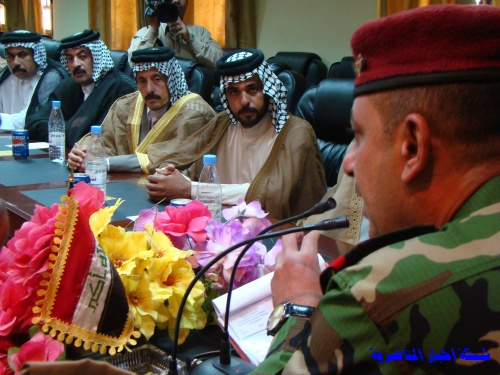
The reports keep getting more persistent: Nuri al-Maliki is apparently building ties to southern tribes at the expense of – and sometimes to loud protests from – ISCI and Badr. The latest case to receive some attention in the Iraqi press is Nasiriyya and Dhi Qar. Today, leaders of the recently-formed “support councils” (majalis asnad) of Dhi Qar will meet with local security officials, including the police chief (who was appointed by the Iraqi interior ministry and with the support of the Daawa but to strong protests from ISCI in Nasiriyya). At least one Iraqi press report suggests this is an attempt by Maliki to weaken ISCI's local support base in the forthcoming provincial elections. Others who are unhappy about Maliki's scheme include members of the “Council of the shaykhs of the Dhi Qar tribes” which was pro-government back in 2006. Individuals participating in that council include tribal leaders of Bani Hujaym, which also is represented on the provincial council through a shaykh who is an ISCI member.
Maliki is supported in his effort by Muhammad al-Uraybi, minister of state, who has ties to the Al Bu Muhammad tribe of Maysan and also has a Wifaq connection.
6 October 2008: A Constructive Element in Democratic Iraq Policy
There are numerous problems when it comes to Democratic policy for Iraq, but a very useful article in the NYT has highlighted one feature of Barack Obama’s thinking on Iraq that both Democrats and Republicans should take into more consideration. According to the article, which was based on an interview with Obama, “Mr. Obama said he would end efforts to train the Iraqi military if Mr. Maliki’s Shiite-dominated government did not take adequate steps to integrate the largely Sunni members of the Awakening movements into Iraq’s security forces.” Conversely, John McCain had argued that “threats to cut off American training or deadlines for removing combat brigades, …would only prompt Iraq to become more dependent on Iran or turn to militias for security. ‘For a long time, people have said threaten them with this, threaten them with that,’ Mr. McCain said.”
While Obama may be wrong when it comes to the characterisation of the conflict in Iraq as essentially a sectarian one, he is certainly right in thinking in terms of conditionality with regard to US support. A large majority of Iraqis, Shiites and Sunnis, want national reconciliation and constitutional changes, but if the United States does not put pressure on Maliki, he will prefer the more leisurely option of arming the state to deal with dissidents.
Also, in relation to the federalism debate, Maliki’s office today issued a statement to the effect that “federal regions should not be stronger than the central government”, although he was magnanimous enough to concede that “federal regions and governorates will not be abolished or rendered ineffectual”…Surely this debate on state structure has changed over the past year or so.
29 September: More Tension between the Iraqi Security Forces and the Badr Brigades, This Time in Hilla
Contrary to the standard image of the Iraqi security forces as lightly camouflaged members of the Badr brigades, tension between those forces and Badr actually seems to be on the increase. In a recent episode in Hilla, Iraqi security forces carried out a surprise search of the headquarters of the Badr brigades, and according to some reports confiscated both rockets and explosives. The ISCI governor of Babel claimed that only Kalashnikovs were taken and that these were for the “personal use” of the Badr members.
Assuming that the reports are genuine and that this was not a staged event of some kind, the episode is interesting because it seems to add to a more general trend. Earlier this year in Maysan, posters of Hakim were torn down during operations carried out by the security forces. Some months ago, ISCI protested strongly against the interior ministry’s appointment of a new police chief in Nasiriyya. Some reports claim that the notorious “Scorpions” of the Iraqi security forces took part in the recent Hilla operation, even in cooperation with US forces. Earlier, the late police chief in Babel, Qays al-Mamuri, had fought Badr with determination.
Moreover, the incident throws into question the true degree of demilitarisation as regards the Badr forces and other pro-ISCI elements. It is worth recalling that as late as 2007, the leader of “Hizbollah in Iraq”, an integral part of ISCI, made a public request to Maliki to have his “30,000 militiamen” integrated into the Iraqi security forces and complained that no action had been taken.
In other news, Wifaq and al-Hiwar al-Watani have decided to contest the local elections on a joint ticket, with Hiwar’s leadership specifically rejecting an alliance with (Sunni-dominated) Tawafuq on the grounds that they found it “too sectarian”. That’s a step in the right direction, but where are Fadila, Jaafari's Islah, the UIA independents and the tribal leaders?
25 September: More on the Elections Law
The Iraqi parliament has now published what is supposed to be the final version of the elections law. One remaining caveat concerns the discrepancy between some of the articles in the published version and those quoted in yesterday’s official press release from the parliament, especially concerning articles 32 and 35. The second point about a permission to use symbolism related to non-candidates except “religious authorities” (maraji‘ al-din) has been omitted in the complete version of the law, and article 35 sounds altogether different from the original: the press release referred to a permission to use public buildings and mosques for “information purposes” related to the electoral process but not for political campaigning as such, whereas the newly released text bans the use of government offices for campaigning purposes but expressly allows it in mosques and places of worship. While the “change” to article 32 may be a case of an oversight by the website staff, the differences between the two versions of article 35 are substantial. It could be simply the case of a wrong draft having been used, but it might also reflect some last-minute changes to the law that have not yet received the attention they deserve.
Another notable feature of the released law is the non-mention of Kurdistan, where leaders reportedly have decided not to carry out elections. They appear to be doing this unilaterally – it is not something that is explicitly part of the law, whose language itself is general and refers to “all the governorates” with no other exception than Kirkuk.
There has been a degree of confusion in the press about the women’s quota: this quota was adopted already on 22 July, but back then it was purely aspirational – no mechanism for arriving at the quota was defined other than an instruction to parties to nominate a certain proportion of women. Now, the counting of the open lists results is arranged so that every fourth* winner from these lists will be a woman, but there is no guaranteed quota (theoretically, in some small electoral districts male independent candidates might win all the seats) and the specific goal of 25% does not appear in the final version of the law referred to above.
Finally, there has been some debate about the omission of a total of 13 seats that had been reserved for “micro-minorities” (including Yazidis, Shabak, Sabaeans, Christians) in the original 22 July version of the law (though no modalities for their election had been specified). A third of these seats were in Kurdistan and another two in Kirkuk. Some minority representatives have protested against what may possibly have been horse-trading between Kurdish and Iraqi nationalists; others may hope that the renewed focused on national unity in the parts of Iraq south in Kurdistan in itself may offer new possibilities for minorities without any need to resort to a quota system.
*Or more probably every third? The original has "At the end of every three winners there should be a woman irrespective of men winning [more votes]".
21 September: ISCI vs the interior ministry in Nasiriyya?
The police commander of Nasiriyya, Sabah al-Fatlawi, is in the news today due to his complaints of “special groups” that are entering from Iran through Maysan and then go on to commit mischief in the Iraqi south. Fatlawi has an interesting background: his appointment by the ministry of interior was furiously resisted by ISCI back in June, with protests about his alleged “political” ties. Fatlawi was backed by Daawa members in the governing council.
This episode is interesting for a number of reasons. Firstly, it might be of relevance to the question of tension between Maliki and ISCI, possibly with Jawad al-Bulani (minister of interior) on Maliki’s side. Secondly, Daawa in Nasiriyya primarily means the notoriously elusive Tanzim al-Iraq branch: they now seem to support the security forces of the government. Finally, ISCI was supported in its opposition to Fatlawi by Fadila, which is their arch-enemy in neighbouring Basra and in Iraqi politics more generally.
20 September 2008: Two Very Different Takes on Centralism
Diverging opinions on the virtues of centralism as a principle of government have created tensions between the Daawa party and ISCI for some time, yet without escalating to the point where their alliance appears to have been under serious threat as such.
It is nevertheless interesting that over the past two days, the two opposing poles have expressed their conflicting views on the issue with almost perfect synchronisation. In an interview in al-Hayat, Nuri al-Maliki largely reiterated his position on federalism along the lines he described it an earlier interview back in November 2007: federalism is a constitutional option, but not something that should threaten the potency of the centralised state. Conversely, ISCI’s Jalal al-Din al-Saghir expressed the exact opposite attitude in Friday prayers yesterday, describing “centralism” as a distinguishing feature of the old Baathist regime.
There can be little doubt that to Daawa, centralism remains a positive concept while to ISCI, it has negative connotations. This is interesting, because at least since the release of the main draft of the oil law in early 2007 it has been plausible to ask whether ISCI pursues a centralist plan B as an alternative to its severely criticised scheme for a large federal Shiite region south of Baghdad. As of today, it seems as if ISCI still has some internal debating to do before the party can be at ease with the idea of centralism in the same way as the Iraqi premier and some of the circles around him. Oil minister Husayn al-Shahristani, for example, seems to belong to the latter camp in this question: In an interview in today’s Al-Sharq al-Awsat he criticises the Kurds for obstinacy with regard to the oil law and contends that the only option left to “the Baghdad government” would be to revert to Saddam-time legislation. The symbolic significance of this kind of adoption of Baathist centralism by the new Shiite-dominated regime would be quite considerable.
Importantly, though, others see it in a different ways: in the context of the stalled debate over the provincial elections law and military operations by the central government in Diyala, Kurdish politician Qadir Aziz today speaks about a conspiracy against the Kurdish cause and he mentions both ISCI and Daawa as part of the conspiracy.
11 September 2008: Hakim’s Insincerity on the Local Elections
In a strange series of comments given to the Iraqi news agency Aswat al-Iraq, Ammar al-Hakim highlights the importance of holding early provincial elections and seems to forget that his own party, ISCI, has been at the forefront of attempts to derail those elections. First, back in February, ISCI along with the Kurds fiercely resisted the insertion of a timeline for elections into the provincial powers law. Subsequently, after having been defeated by a parliamentary majority on the issue, ISCI tried to use the presidential veto to avoid elections. More recently, ISCI has continued to complicate the parliamentary deliberations on the elections law itself through continuing to demand the right to use religious symbols for campaigning purposes. In a remarkable statement in the most recent interview, Hakim refers to the “timeline for elections laid down by the Iraqi constitution” – surely he must know that there is no timeline for local elections in the constitution.
Perhaps sensing a degree of pressure from the higher Shiite clergy, Hakim now tries to present ISCI as an advocate of early elections – unsurprisingly, he now blames the very parties that demanded elections in the first place for trying to obstruct them! This refers to the demand by a majority of Iraqi parliamentarians that pending elections in Kirkuk, and as part of the elections law, there should be some kind of shake-up in the local administration there in the direction of greater power-sharing between the various communities. This demand reflects a widespread desire among Iraqi parliamentarians to challenge the hegemony of ISCI, the Kurds and Maliki in dominating Iraq’s politics – a hegemony which came under threat when the provincial powers law with the timeline for elections was adopted back in February, but which has since been restored through heavy-handed action (often with US support) against political enemies of all shades, in many cases on the pretext of vaguely defined “security” concerns that have yet to result in formal charges against those targeted in the operations.
In the interview, Hakim is less bullish than ever before on the idea of forming a big Shiite region. This time, he merely refers to the constitutional provisions on the subject, which leave the issue to popular grassroots initiatives.
8 September 2008: Biden Gets Specific on Iraq – Again
Immediately following his nomination as Democratic VP candidate, there were certain signs that Joe Biden was playing down his plans for an “active federalisation” of Iraq. However, now he is picking up where he left off. The following quotes are from “Meet the Press” on 7 September, along with some annotations in brackets:
“Everything that’s working in Iraq has been the bottom up approach, not a strong central government imposing. And the truth of the matter is the only way you’re going to make this–sustain it, the question is, how do we leave and leave a stable Iraq behind? Without a political settlement, Tom, we’re going to be back there in another year or two or three or five.”
[Here Biden reiterates a common misunderstanding of the Iraqi constitution. The Iraqi constitution outlines a hybrid asymmetrical federal system under which the various parts of the country can choose between remaining under the central government OR becoming a federal region – through specific procedures. Biden violates both these features: first he rejects the idea of asymmetrical federalism by excluding the possibility of some provinces remaining under the central government, then he goes on to push for a “settlement” instead of accepting the gradual evolutionary process foreshadowed in the Iraqi constitution.]
“MR. BROKAW: But the Iraqi government didn’t like the idea [i.e. Biden’s “plan”]. Maliki…
SEN. BIDEN: Well, the Iraqi government–Maliki didn’t, but the rest of the government liked it.
MR. BROKAW: But he is the head of the government. It’s their country.
SEN. BIDEN: Yeah–by the way, it is their country, but he’s the head of the government, but he’s the head of the government whose popularity is very much in question, and the election itself.”
[Biden apparently hasn’t noted that except from the Kurds and their partners in the Maliki government (ISCI), pretty much everyone else in Iraq is against his plans. These days, even ISCI seems to have second thoughts with regard to the wisdom of soft partition.]
“MR. BROKAW: Five years from now, do you think Iraq will have relative stability and democratic principles in a central government?
SEN. BIDEN: If there is an Obama-Biden administration, yeah. If there is a John McCain administration and Sarah Palin, I think it’s probably not going to happen, because John does not view this in terms of the region. I never heard him speak about how he’s going to integrate Iraq into the region where you have these competing interests that exist.”
[This is the truly frightening part. Integrate Iraq into the region?? After it has first been soft partitioned a la Biden? Sounds bad if you consider yourself an Iraqi.]
7 September 2008: The Sahwa of the South
The ”Council of the Tribes of the Sons of the Arab South” (various versions of the name occur but the leadership figures seem constant) has called for the ministers of electricity and trade to be sacked. This council is an interesting example of tribal cooperation in the far south (Basra, Dhi Qar, Maysan) where the anti-Iranian theme is extremely pronounced and where there are calls for better relations with Arab Gulf states. In other words, combining local regionalism, Iraqi nationalism and pan-Arabism, this represents the quintessential sahwa of the south – except that Washington’s preference for working with Nuri al-Maliki, ISCI and others with a more pro-Iranian attitude prevents it from replicating the Anbar experience south of Baghdad.
3 September 2008: Muqtada’s Northern Strategy
In a message attributed to him and published in Kufa on 29 August (but as of yet unconfirmed at many key Sadrist websites) Muqtada al-Sadr supposedly stressed the importance of ejecting the Kurdish peshmerga from Khanaqin so that they can be replaced by Iraqi government forces.
If correct, this would serve as another reminder of Muqtada’s intentions to play the Iraqi nationalist card in the north, which he has done previously as well, with major Sadrist demonstrations against federalism in Kirkuk back in 2004. At the same time, Sadr’s insistence on consistency touches on cracks in the alliance between ISCI and Kurds that forms the backbone of the Maliki government: “You were the first to insist on imposing the law in the governorates of the centre and the south of Iraq, so why reject this idea in Khanaqin” Sadr asks. Perhaps tongue in cheek, but still an interesting contrast to 2003 when Sadr at one point contemplated the formation of a “shadow cabinet” to challenge what he described as illegitimate government structures sponsored by the United States.
29 August 2008: The Arrest of Ali Faysal al-Lami
There are problems concerning the portrayal in some media sources of Ali al-Lami – the de-Baathification director captured recently by US forces on suspicion of pro-Iranian activities – as a straightforward “Sadrist”. Lami, whose name suggests a link with the Bani Lam tribe of Maysan in the far south, has a long history of association with Ahmad Chalabi and Abd al-Karim al-Muhammadawi who back in 2005 participated in a party called the “Shiite council” – one of the first Iraqi parties to use Shiite sectarian identity in such an explicit way in its name. Jawad al-Bulani, the current ministry of interior, at one point also belonged to this circle.
There are many other individuals in the United Iraqi Alliance who since 2005 have floated between several camps – they include figures like Sami al-Askari and Jabir Habib Jabir. It seems inconceivable that Lami should have been able to hold on to his current position for so long time unless the Maliki regime saw certain advantages in having him there.
28 August 2008: In Denver, No “Plan for Iraq” Yet
In a positive development, Senator Joe Biden yesterday refrained from any mention of his previous “plans for Iraq” which include a soft partition scheme and a more recent (and more general) plan for “active federalization”. Instead he referred more generally to Barack Obama’s position on the war in Iraq.
What remains for the Democratic Party is to define an exit strategy that does not convert the Iraq situation into a net gain for Iran. As long as the final phase of the US occupation of Iraq involves consolidation of the Maliki regime and the basic system of government adopted in 2005 (rather than a weakening of these two factors) such gains for Iran will be the inevitable outcome. What is missing in Democratic discussion of exit strategies is the realisation that US policies in Iraq from 2003 to 2008 (and specifically Washington’s particular choice of partners among the Shiites) have unintentionally strengthened Iran’s position in Iraq quite considerably, so that leaving Iraq tomorrow would not in any sense mean a return to the status quo ante of 10 April 2003. This point may perhaps seem a little long-winded for an election campaign where there will be a preference for black and white caricatures, but for those who truly care about the political stability of the Gulf region in the long term it should be seen as the fundamental issue.
21 August 2008: The USG Formally Embraces the Minority View in the Kirkuk Question
Yesterday, US Ambassador Ryan Crocker explicitly extended his support to a UN proposal of delaying the provincial council vote in Kirkuk apparently without making any substantial changes to the province’s current political line-up, while allowing the vote to go ahead in the rest of Iraq’s governorates. It is noteworthy that this is the model that was earlier rejected by a majority of Iraqi parliamentarians (who favoured a new power-sharing arrangement in Kirkuk in the interim), and was not brought to a vote despite attempts by the government to push it through in early August after the presidential council had vetoed the decision of the Iraqi parliament to create a power-sharing regime in Kirkuk.
The upside of the UN approach to Kirkuk is that it is part of a grand strategy of diluting territorial issues in northern Iraq by tackling them piecemeal, starting with the easiest ones. This is a good approach because there are certain “disputed” areas that are not really disputed and which many Iraqis, regardless of ethnic origin, would be quite happy to assign to the Kurdish federal region. This approach would also contain the application of the concept of “disputed territories” to the north – an important factor with regard to political stability given that ISCI in particular has shown a proclivity for thinking in similar terms in the south, for example in possible border adjustments between Karbala and Anbar. Theoretically this could form the basis for a grand compromise on territorial changes in the north that could bring closure to the Iraqi federalism debate and a renewed focus on development issues more broadly.
What is less clear is why this process should require a perpetuation of the status quo in the provincial government of Kirkuk. If instead steps towards a modicum of power sharing were implemented, there are greater chances that any grand “final status” deal would enjoy credibility in the eyes of the majority of Iraqis. The proposal of the majority of the Iraqi parliament needs not be the perfect approach, but there is a clearly expressed desire not to carry on with existing arrangements, which are seen as strongly supportive of the Kurdish position. This stance represents a challenge to the forces that see the 2005 constitution and the political set-up it created as a viable way forward, and for the USG to persevere in ignoring the majority of the Iraqi parliament on this issue seems like an almost self-destructive strategy. If anything, the forces that find it difficult to consider Kirkuk as anything other than “Iraqi” – and which therefore are reluctant to acquiesce in what is seen as undemocratic special arrangements for the area – are probably even stronger outside parliament than inside it.
20 August 2008: More on Diyala
Today there is an attempt by Iraqi authorities to gloss over the Diyala episode by blaming it on technical misunderstandings between various arms of the Iraqi security apparatus: the local police versus a special force from Baghdad. This cannot disguise the fact that a week ago, and reportedly by consensus, the provincial council which includes 20 members from the Shiite Islamist camp (many of them ISCI*) voted to oust the police chief, Ghanim al-Qurayshi, whom Baghdad had earlier appointed probably with the support of Nuri al-Maliki and Jawad al-Bulani. Demonstrations against the dismissal, allegedly to a large degree made up of members of the police loyal to Qurayshi, had met with the disapproval of the governor who has ties to ISCI. There clearly is some kind of intra-Shiite dimension to this affair, but it remains unclear whether it is a case of a local branch of ISCI cooperating with non-Shiites in a bid to oust an outsider appointed by Maliki, or another example of tension between ISCI and forces more loyal to Maliki.
* The list of coalitions from the Iraqi electoral commission dated 20 December 2004 provides the following overview of the constituent elements of the two formal political alliances in Diyala: List 302, the Kurdish-Turkmen-Arab Alliance, made up of PUK and KDP (the two biggest Kurdish parties), and list 339, the Alliance of the Islamic and Nationalist Forces in Diyala, consisting of three elements: Daawa, SCIRI and Badr. In the January 2005 elections, list 302 won 7 seats, list 339 won 20 seats, and list 351, the Sunni-dominated IIP, got 14 seats.
19 August 2008: The Powers That Are Divided among Themselves
Recent events in Diyala provide yet another indication that all is not well inside Iraq’s ruling establishment, especially with regard to its dominant component of Shiite Islamists. Presumably with the support of premier Nuri al-Maliki, Iraqi government forces yesterday raided the premises of Diyala governor Raad Rashid al-Mulla Jawad (linked to ISCI in many reports). Earlier, on 12 August, the chief of police in Diyala was sacked by the provincial assembly, ostensibly because he had promoted “ex-Baathists” to high positions in the local police force. The interior ministry was reportedly unhappy with the action taken by the provincial assembly.
On the surface, Diyala seems like a manifest example of the alliance between Kurds and ISCI that forms the increasingly feeble parliamentary backbone of Nuri al-Maliki’s government: these two forces dominate the local assembly and key positions in the local administration. However, these fiefs now appear to be coming under attack from forces loyal to Maliki himself. Before he was accused of promoting “Baathists” in Diyala, the sacked police commander, Ghanim al-Qurayshi, had reportedly been under consideration for transfer to Basra to assume even more important security tasks, suggesting that he has friends close to Maliki.
This is not the first time there has been friction inside the Shiite establishment. On 29 May, the provincial council in Dhi Qar rejected the interior ministry’s appointment of Sabah al-Fatlawi, against the votes of the Daawa (Tanzim al-Iraq) branch. Earlier, in February, Daawa along with Fadila had sidelined the provincial security council where ISCI was strong, prompting protests from ISCI about the police forces “becoming politicised”. And all too often it is forgotten that the top Basra security officials that came under attack by ISCI and the Sayyid al-Shuhada movement shortly before the military operation in Basra in March were in fact Maliki appointees. In light of examples like these, it is extremely difficult to maintain the common notion that ISCI has perfect control of the Iraqi security forces in most part of the country, although in the case of Diyala it remains unclear whether this is the result of an internal split inside ISCI (national versus local leaderships) or tensions between ISCI and Daawa.
Meanwhile, the corporate media is already feverishly reporting the Diyala developments as a purely sectarian affair, conveniently ignoring the fact that the Sunni Islamist IIP holds only 14 seats out of 41 on the provincial council that voted to oust the Shiite police commander (and whose governor is also a prominent Shiite leader who used to be criticised for ties to Badr).
[Most of this note is also available in an Arabic translation provided by the Iraqi news agency Aswat al-Iraq.]
17 April 2008: General Mohan Is Transferred to Baghdad - New Security Regime in Basra
On 16 April 2008 the Iraqi government confirmed that its two top security officials in Basra - General Mohan al-Firayji as well as Abd al-Jalil Khalaf - had been transferred to “high-ranking positions” in the defence ministry in Baghdad. The transfer seems to have been a demotion in everything but the name.
It can be useful to briefly recapitulate the circumstances surrounding the rise and fall of these two officers. Early in 2007 General Mohan had reportedly been among Nuri al-Maliki’s candidates for leading “the surge” in Baghdad, and when he was sent to Basra in the subsequent summer he was very much seen as Maliki’s man. By the autumn both British and Americans tended to indulge in panegyrics about Mohan whenever questions about Basra’s security situation arose. Such was the faith in one man’s ability to control Iraq’s second city that on many occasions, leading US officials were content to refer to the “tough four-star general” as a guarantor for Basra’s tranquillity. Both Mohan and Abd al-Jalil Khalaf reportedly shared an anti-militia attitude; Khalaf also went further than any of his predecessors in highlighting the plight of Basra women and their exposure to extreme pressures from radical Islamists.
Rumours about Mohan’s removal being imminent began circulating in December 2007 and intensified on the eve of the recent Basra clashes, when Maliki travelled to Basra to personally oversee the operations. Thus, Mohan’s decline was in progress prior to the latest showdown with the Sadrists and certainly not something that came about as the result of that fighting. Around a fortnight prior to the operations, Mohan complained about “Iranian” influences in Basra at a time when he and Khalaf were subjected to angry demonstrations by members of the Islamic Supreme Council of Iraq (ISCI) and the Sayyid al-Shuhada movement. Khalaf also had gone quite far in criticising the Sadrists through his singling out of port management (a long-standing Sadrist fief) as a sphere of undesirable militia activity.
The replacements for the two demoted officers are reported as Muhammad Jawad Huwaydi (chief of operations) and Adil Dahham (police chief). Background information on the two is sketchy so far, but it is noteworthy that Huwaydi seems to have had some kind of special operations background before he assumed control of the 14th division of the Iraqi army. Unlike Mohan, he is thought to be from outside the area. As for the new police chief, who was previously employed in Baghdad, someone in the defence ministry with an identical name (the new appointee is sometimes referred to as Adil Dahham al-Amiri) was cleared by the de-Baathification committee in early 2007. If this turns out to be the same person, it would suggest a background from the old Iraqi army rather than a long-time connection with ISCI’s Badr Brigades.
While it is true that there is a conspicuous link here to the early March demonstrations by ISCI/Sayyid al-Shuhada (which specifically requested the dismissal of General Mohan and Abd al-Jalil Khalaf), it is also worth recalling that in the same period, ISCI members circulated rumours about yet another attempt to have Maliki replaced by ISCI’s own Adil Abd al-Mahdi, not least because of dissatisfaction with Maliki’s centralist stance on the provincial powers act. Crucially, the rumours of a replacement of Mohan in Basra antedated all these events. Apparently, then, the dominant parties of the Maliki government have been brought closer together by the latest series of crises, rather than having pursued a shared agenda consistently for several months. Recent reports of increased pragmatism on the part of Maliki vis-à-vis Kurdish claims in the oil question could be another expression of a ruling clique that sees the necessity of first and foremost staying united in the face of growing parliamentary opposition of the kind seen in the debate over local elections - where Sunni and Shiite Islamists as well as secularists came together to challenge Maliki in a demand for early elections.
27 March 2008 : The Fadila Party Criticises the Basra Operations
[Postscript to The Enigmatic Second Battle of Basra ]
After a long silence on the Basra operations, the parliamentary bloc of the Fadila party has within the past hours released a statement criticising the impact on civilian life in Basra and asking for an end to the operations “as soon as possible”. This is not quite as hostile as the reactions by the Sadrists, but it underscores internal Shiite divisions regarding control of Basra and shows how little room for manoeuvre Nuri al-Maliki really has. His remaining allies are ISCI, Daawa and the independent Shiites, but neither he nor the independents share ISCI’s preference for a weak central government. Unless Maliki is able to secure defections from ISCI (or a change of their policy in the federalism question) this seems to be a poor basis on which to build a coalition.
27 February 2008: ISCI Faces Challenges in Nasiriyya; Provincial Powers Law Vetoed
With the exceptions of oil-rich Basra and Maysan, the Shiite-majority governorates south of Baghdad are frequently referred to by observers as the loyal fiefdoms of the Islamic Supreme Council of Iraq (ISCI), America’s and Iran’s principal partner among the Shiites of Iraq. However, on the eve of Arba‘in - a holiday marked by the Shiites as ending the 40-day mourning period for Imam Hussein that starts on Ashura every year - Shiite Islamist politicians in the southern city of Nasiriyya have engaged in an intense internal struggle about the local security forces, casting doubt on the image of ISCI hegemony. On 25 February, a two-thirds majority of the governorate council decided to dissolve the local security council and transfer its powers to the local police chief instead.
This development is noteworthy for two reasons. Firstly, it is taking place in a setting - the provincial council - where no Sadrists are represented because they boycotted the January 2005 local elections. In other words, it is other Shiite Islamist forces, primarily Fadila but probably also at least some members of Daawa (Tanzim al-Iraq) that are behind the move. Whereas ISCI originally had managed to install their own man as governor of Nasiriyya, they are now being threatened from within in one of their supposedly “safe” constituencies. In this respect, Nasiriyya could be a bellwether for this autumn’s provincial elections: despite ISCI’s dominance in terms of numbers of governors, many of “their” governorates south of Baghdad (including Karbala, Qadisiyya and Samawa) have a rather complex party structure. The Sadrist challenge would come on top of this, as they are now signalling an eager desire to engage in electoral politics.
Secondly, it is significant that ISCI’s opponents are deciding to strengthen the powers of the local police. This means that the image of full ISCI dominance in the security apparatuses of the south probably requires more nuance. In the case of Nasiriyya, it is actually ISCI who are now complaining about “party loyalties” exercising influence in the police force. That could be a result of increased local competition by other local parties asserting themselves in the security apparatus, but it could also be an expression of a conflict between ISCI and parts of the security forces that are more loyal to Nuri al-Maliki (and the central government) than to Abd al-Aziz al-Hakim - two leaders that increasingly have been at odds with each other over the past months.
The national aspect of this struggle was also emphasised today as the Iraqi presidency council issued a statement to the effect that it had vetoed the recent law passed by parliament on the powers of the governorates not organised in a federal region. The law and especially its provisions for early provincial elections had been resisted by ISCI and the Kurds, who control the presidency and two of the three vice-presidential positions. The presidency council today emphasised that elections would go ahead on time, but the legislation is nevertheless sent back to parliament, ostensibly to sort out unspecified “constitutional” issues relating to the powers of the governors.
9 December 2007: Anti-Sectarian Police Commander Is Assassinated in Babel
The news about the assassination of Babel’s police chief Qays al-Ma‘muri today is particularly tragic to those who are hoping for the restoration of a non-sectarian Iraq where ethno-religious identities are in the background. For several years, Ma‘muri had stood out as an honest figure of authority in the mixed governorate of Babel, and had fought hard against militias regardless of their sectarian affiliations.
Already, some newswire reports speak of “suspicion towards al-Qaida”. In the absence of further evidence, such accusations should be treated with caution. In several cases of violence in the Shiite-dominated parts of Iraq - including Basra before the imposition of a state of emergency in May 2006, and Najaf during the battle with the “Soldiers of Heaven” in January 2007 - vague references to al-Qaida were used by Iraqi government sources to gloss over episodes that clearly featured elements of intra-Shiite conflict.
Instead, it may be worth looking at how al-Ma‘muri’s conflict with various Shiite militias unfolded in the past. In May, 2006, for example, Bartle Bull wrote in the New York Times,
“What really makes Babel special is that it is a largely Shiite province in which the Shiite militias - the Mahdi Army and the Badr Brigades - have almost no foothold. But they are trying. All Iraq’s police answer to the Interior Ministry, which is held by the Supreme Council for Islamic Revolution in Iraq, the main Iranian organ in the country. And the interior minister, Bayan Jabr, has repeatedly tried to replace Babel’s independent-minded provincial police chief, Gen. Qais Hamza al-Maamony. Under heavy pressure from the Americans, however, the minister agreed in January to a moratorium on the replacement of senior police officers until after the formation of the new government. Nonetheless, according to American officials in the province, General Maamony was recently forced to accept 700 candidates recommended by the ministry - that is, by the Supreme Council for Islamic Revolution - for the incoming class of the provincial police academy. The police chief, I’m told, plans to spread these recruits as thinly as possible around the province upon their graduation to lessen their impact on the force. General Maamony and his 8,000 men - especially the provincial SWAT teams, which supply the muscle that the relatively poorly trained and lightly armed regular police often cannot or will not provide - are understandably unpopular with the council and its military wing, the Badr Brigades. And they are equally feared by the Mahdi Army of the rebel Shiite cleric Moktada al-Sadr.”
Subsequently, in August 2006, there was an attempt by the SCIRI-dominated provincial council to unseat Ma‘muri - but on that occasion he was defended by the central government and the interior ministry which by now had passed into the hands of the more independent Jawad al-Bulani. However, only a few days ago, Iraqi media reported renewed attempts by the ISCI-led provincial council to get rid of Ma‘muri by having him transferred to another part of the country. Also, there have been reports about conflicts between Ma‘muri and the Sadrists.
Already today, some Iraqi press stories make accusations about Shiite factions being behind the assassination - with one source even blaming Nuri al-Maliki’s wing of the Daawa party. Whoever committed this crime, it is now up to the Iraqi government to conduct a credible and transparent investigation of the affair instead of automatically resorting to the predictable explanation of al-Qaida terrorism.
4 September 2007: Local Reactions to the British Withdrawal from Basra: Sadrists Claim Victory
Perhaps the most important aspect of the recent British withdrawal from the urban centre of Basra to a base near the city’s airport is the reaction from local political forces. So far, the loudest response has come from the Sadrists, who publicly claim that their armed campaign led to the British withdrawal.
The Sadrists claim is in fact a remarkable echo of events that took place as early as 2003. On Friday 6 June of that year, Sadrists demonstrated peacefully in the city of Basra. Their principal demand was as follows: the withdrawal of British forces from the population centres of Basra, and the concentration of all foreign forces “at locations on the outskirts of the city”. In the subsequent period, the Sadrist protests gradually grew more violent, and Basra soon became more dangerous for British troops. As early as 2004, British influence was in steep decline. In other words, the recent pullout itself was a largely symbolic affair: the British ceased exercising effective control of Basra a long time ago.
Also Western commentators - particularly in the United States - have suggested that the Basra pullout represents “British defeat”. However, that judgment rather exaggerates the differences between “gangland Basra” and what is construed as the more “pacific” central parts of Iraq. The main difference between the US and the British approach does not relate to militia power as such, but rather to the extent to which there has been an attempt to manipulate the political games in which the militias take part. In the south, the British have largely maintained a neutral position, with a variety of armed factions coexisting in some kind of uneasy equilibrium, and with a diverse range of political forces gaining power: the Islamic Supreme Council of Iraq (ISCI, formerly SCIRI) in Samawa and Nasiriyya; the Sadrists in Amara; Fadila in Basra. In the rest of Iraq, US forces have largely allied themselves with Kurdish and ISCI parties and their militias (technically “integrated” in the security forces and the Iraqi army), and have supported these groups in their efforts to suppress internal dissent. Ideologically, this has been presented as an effort to build a “moderate” base; in practice it has involved giving consent to much highhandedness by local authorities. Thus, repression and militia rule are not absent from the US-controlled parts Iraq, but they take on a more orderly form than in the far south. In fact, in many ways it was the early US concessions to the ISCI-Kurdish militia axis that emboldened these parties to make maximalist demands on issues like Kirkuk and a single Shiite federal region and in turn created many of the subsequent complications in the process of national reconciliation in Iraq. Washington apparently had to do this because its own military strength in Iraq was deemed insufficient - something which British military authorities, for their part, were critical about early on.
Over the coming months, both the position of the Sadrists and the further development of militia relations in Basra will be crucial. There is some indication that relations between Fadila (which remains in control of the governorate despite a vote of no confidence) and Sadrists have improved slightly during the summer. Muhammad al-Waili, Basra’s governor, has spoken out for the release of Sadrist prisoners held by the British. The Sadrists in the Iraqi parliament appear to have backed Waili in his confrontation with the Maliki government: it was the Sadrist chairman of the legal committee in Iraq’s parliament who signed a recent letter of protest against the government’s decision to remove Waili. On the other hand, ISCI has in the past been skilful in forestalling alliances between its two main competitors in Basra, and, moreover, could now benefit from the handover to Iraqi government forces.
Westminster-centric analyses of the British withdrawal have pondered whether the timing was linked to the Labour Party’s upcoming annual conference. The more important question is who will be Basra’s governor three months from now. It would be a setback to the image of the Iraqi army as a “neutral player” if the first thing to happen after the British withdrawal were the ouster of Fadila and the fall of one of the last bastions of resistance to ISCI rule in the Shiite parts of Iraq.
23 June 2007 Iraq Inches Closer to Oil Legislation Deal but Key Issues Remain
On 21 June 2007 in the evening, the Kurdistan Regional Government made public the draft law for financial revenues which has been negotiated with the central government in Baghdad and which will form part of a wider package of oil-related legislation also to include laws for the administration and organisation of the oil sector and foreign investment (“the oil law”), the reorganisation of the oil ministry, as well as the reconstitution of the Iraq National Oil Company (INOC).
Until now, the focus has been on the “oil law” itself, of which a final draft was leaked in March this year. This law should since have been presented to parliament but negotiations have stalled, mainly due to differences between the Kurds and Baghdad over which fields should be defined as open for foreign investment - where the Kurds are pressing for an enhanced foreign role.
This new draft is on a different track, mainly relating to revenue-sharing. What it does with regard to the centre-periphery balance in the Iraqi federation can be summarised as follows:
· It pools all the country’s financial income - not only from oil but also from taxes raised and external loans etc. - into two central accounts (one “external”, including all oil revenue, another “internal, for taxes and fees)
· It identifies two areas where the central government can make deductions from these accounts: federal spending, as well as a “future fund”
· The remaining funds are to be divided between the Kurdistan Region (which, pending a census, will receive 17%) and the governorates not organised into a region (which will receive a share according to their “population density”)
· There will be peripheral dominance of the commission charged with oversight of the funds, but there will be no distinction between regions and existing governorates and hence no incentive to federalise (in contrast to the “oil law” where such an incentive exists)
· As with many of the laws of today’s Iraq, there are obvious areas that need more detailed legislation or where ambiguities may arise (e.g. the law for the future fund and conflicts between regions and central government). In these contexts, the absence of a functioning constitutional court represents an acute problem, and the text of the law reflects this problem by partially referring to the constitution but also proposing certain ad hoc rules of its own.
The language of the law clearly demonstrates that above all this has been a bilateral negotiation process between Arbil and Baghdad, and the Kurdish position is interesting: on the one hand they have ensured a theoretical regional quota for every dinar that goes into the state coffers (i.e. not only oil, but also taxes - possibly in anticipation of changes to the constitution that could grant taxation powers to the central government); on the other hand they have also agreed to two headings under which deductions from the total income can be made before the distribution of revenue is initiated. In this way, the law should give the Kurds a stake in maintaining a functioning central government and a working relationship with Baghdad, and it is only to be hoped that a similar attitude should prevail also in the stalled negotiations over the oil law itself.
So far external actors like the United States have focused more on revenue-sharing than on the organisation of the oil sector. But whilst Washington may find what it seeks in this part of the oil package, many Iraqis are more interested in adjustments in a more centrist direction with regard to the oil law itself (concerning the organisation of the oil sector) - or may wish for more fundamental changes to the overall constitutional framework before signing up for any fateful decisions concerning the future wealth of their country. The latest reports on the constitutional revision process is that yesterday’s deadline for a report to be presented to parliament has passed and that there is talk of further postponement.
27 April 2007: Towards a Political Earthquake in Basra?
The political situation in Basra has been tumultuous for some time. But for the first time since January 2005, serious questions have emerged about the internal stability of the governing coalition in Iraq’s most important oil city.
In January 2005, the Fadila party won control of the provincial council in Basra, by establishing an alliance with three other parties and thereby sidelining the Supreme Council for the Islamic Revolution in Iraq (SCIRI). Until now, the junior coalition partners have stood shoulder to shoulder with Fadila during its various challenges - whether from SCIRI, the central government, or, more recently, from Basra supporters of Muqtada al-Sadr. The Harakat al-Daawa (a breakaway faction of the Daawa movement) has been particularly supportive of Fadila’s campaign to establish Basra as a small-scale federal region, either on its own, or along with its two neighbouring governorates.
This week, there have been claims that Fadila’s three coalition partners (the secular Wifaq, Harakat al-Daawa and another “independent” Islamist party) have entered into a new “moderate” alliance (Al-Wasat), separate from both Fadila and SCIRI. This coincided with renewed calls by SCIRI for the Fadila governor of Basra to resign. Importantly, today, sources supposedly speaking for the newly formed Wasat have told reporters that they too demand the governor’s resignation.
If confirmed, this could mean the end of Fadila rule in Basra. However, according to Iraqi law (which in this case means CPA order no. 71 on local government), dismissing the governor would require a two-thirds majority, or 28 out of 41 assembly seats. Currently, SCIRI with its coalition partners control around 20 seats, and the newly formed Wasat bloc holds 9 seats - if the bloc exists, that is. In other words, the entire Wasat coalition would have to abandon Fadila if any change were to be brought about.
There is much to suggest that there is not yet any consensus on this: the “sources” from al-Wasat were unnamed, and Fadila sources deny that any move to unseat the governor is underway. In fact, one of the putative Wasat members (the Tajammu‘ ‘Iraq al-Mustaqbal, which holds two seats on the local council) denied having any connection whatsoever with the new “bloc”. SCIRI will probably try to play up the confused situation as much as possible, but until there is a clear two-thirds majority opposed to Fadila, the current governor may well survive in his somewhat precarious position.
15 April 2007: Mysterious Southern Regionalists Cause a Stir in Baghdad
A conference held in Baghdad on 14 April by members of the Council for the Region of the South (Majlis Iqlim al-Janub) has attracted some interest in the pan-Arab press. The council works for the establishment of a southern region limited to Basra, Maysan and Dhi Qar that would create a wedge internally among the Shiites by concentrating all the oil wealth in a single region and leaving six Shiite governorates without any oil.
The pan-Arab press has focused on negative reactions to the project among Iraqi parliamentarians, as could perhaps be predicted. Historically, even Shiite politicians from Baghdad and Najaf have been uneasy about the zest for autonomy among the population of the far south. Thus it is unsurprising that Ali al-Adib of the Daawa party should criticise the movement and its timing, although the manner in which he did so is quite remarkable: he said that such conferences should not come about without prior agreement with governmental and parliamentarian forces. That sort of comment is of course antithetical to the “federalism from below” spirit of the Iraqi constitution (where regions are to be created by popular initiatives rather than by national politicians), but is perhaps another sign that parliamentarians are ambivalent about the powers they theoretically have ceded in this manner - the Supreme Council for the Islamic Revolution of Iraq (SCIRI) has so far been prominent in trying to impose a federal vision “from above”, namely, that of all the nine Shiite-majority regions south of Baghdad. Negative reactions from Sunni Islamists (who refer to the ongoing process of revising the Iraqi constitution) and “Sadrists” (who on this occasion continue to construe federalism as a plot to partition Iraq) are more in line with expectations, although it is noteworthy that the “Sadrist” press comment was delivered by a Fadila MP from Basra - which could be indicative of the ongoing tension between centralist and regionalist wings inside the Fadila, or a case of a defection from Fadila to the supporters of Muqtada al-Sadr. (The media tend to use the term “Sadrists” for the latter only. Conflict between the two groups have surged in Basra lately.)
The goals of the southern regionalists are well known. They have been pursued for more than two years, primarily by the Fadila party, but also by some secularists in Basra and by tribal leaders in Maysan and Dhi Qar (for background, see for instance http://historiae.org/oil.asp ) The interesting aspect about this story is the identity of the regionalists in question. No names are given in the most recent press report, but an organisation with an identical name was founded in Nasiriyya in May last year - so far without attracting much attention from outsiders. Intriguingly, the leading figures behind that move were from SCIRI, Daawa and various smaller political groups in Nasiriyya. The Sadrists and Fadila were not represented. Of course, the central leadership of SCIRI favours a project which competes with the Region of the South (three governorates) - the far bigger Region of the Centre and the South (nine governorates), and as such the SCIRI-led organisation in favour of a small-scale south at first comes across as an astonishing contradiction.
There are at least two possible explanations. Firstly, regional sentiment in the far south of Iraq is very pronounced and often overrides the ideology of the central leadership of the national parties. This has been seen in Fadila (which has always been more localist in Basra), Daawa, among the Sadrists of Maysan (who sometimes employ regionalist rhetoric in the context of oil), and even among SCIRI members in Basra (some of whom continued to focus on Basra and the far south even after the central leadership had declared a single Shiite region as their goal.) The Nasiriyya-based Council for the Region of the South could be yet another example of regionalist sentiment cutting across ideological affiliations. Alternatively, this may be another instance of a phenomenon seen elsewhere in the south, where SCIRI have created "copycat" organisations in order to gain a foothold in a region where they traditionally have had problems. In Maysan, for instance, there are two Hizbollahs, one tribal and quite secularist, another pro-SCIRI and more Islamist. SCIRI are clearly trying to capitalise on the ongoing tension in the Sadrist camp in Basra between Fadila and followers of Muqtada al-Sadr, and theoretically this latest move by the Council for the Region of the South could have to do with another attempt at breaking down resistance to SCIRI in the far south, by co-opting and diluting it. The fact that the foundation of Majlis Iqlim al-Janub back in 2006 was widely reported in SCIRI and Badr media might suggest that the latter interpretation is the more plausible one.
18 January 2007: SCIRI Members Arrested in Kut
There are intriguing implications to the recent arrest by a joint US-Iraqi force of two members of the provincial council in Kut. Behind the names of the arrestees some interesting political ties emerge: the two happen to be very closely affiliated with SCIRI. One of them, Fadil Jasim, was also arrested by US forces in 2005 in connection with allegations about election fraud in Kut - an episode in which charges about Iranian involvement were put forward.
These are remarkable developments at a time when Washington seems to be moving ever closer to consolidating SCIRI as its principal partner among the Shiites in Iraq. In fact, SCIRI sources claim that President Bush spoke on the telephone to Abd al-Aziz al-Hakim as late as 10 January in the evening Baghdad time, just hours before his address to the nation about Iraq. At the same time, there are reports from other parts of Iraq where local SCIRI elements have protested actions by the Maliki government. During the recent raid on the notorious “serious crimes unit” of the Basra police, SCIRI members of the provincial council were loud in protesting the incident.
What is going on here is unclear. Has SCIRI decided to launch some kind of US-assisted internal purge, possibly with the aim of presenting itself as a “moderate” partner for Washington? Is Maliki finally beginning to override the narrow interests of some of the militant elements that form part of his ruling coalition? Or is the United States acting unilaterally? Some reports describe the incident as an “American” rather than as a “joint” operation, and it more or less coincided with US arrests of Iranian “diplomats” in Iraq - detentions about which SCIRI strongly protested, especially the ones that took place inside the compound of Abd al-Aziz al-Hakim in Baghdad.
Copyright © 2005-2008 historiae.org & Reidar Visser
This document or quotes from it may be freely reproduced as long as www.historiae.org is credited as the original source.
